SEER2 vs HSPF2: Which Rating Actually Matters?
SEER2 vs HSPF2: one rates cooling, one rates heating, and across 92 certified systems they barely track each other. What each measures and which to use.
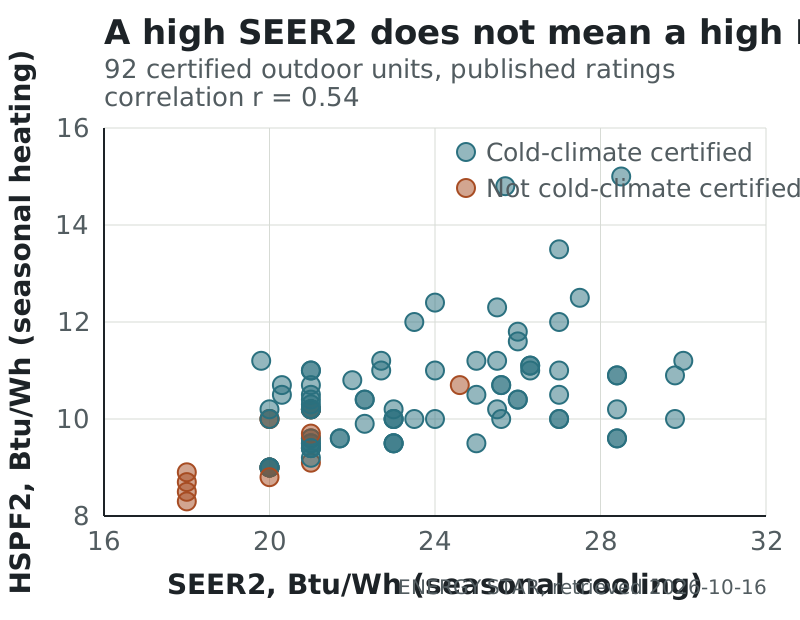
SEER2 vs HSPF2 is the first fork in the road when you start reading heat pump specifications, and most pages answer it with a sentence about cooling and heating before moving on. That sentence is correct but not useful, because it does not tell you which number to weigh when two systems disagree. So I pulled the published ratings for 92 certified ductless outdoor units from the ENERGY STAR dataset and looked at how often they disagree. The answer is: constantly.
The verdict first
If the heat pump is your main source of winter heat, HSPF2 is the number that matters and SEER2 is nearly beside the point. Read HSPF2 first, then immediately check the published heating capacity at 5°F, because an efficient system that runs out of output on the coldest night will hand the load to backup heat and spend your money there instead. Use SEER2 only where cooling drives the bill.
The reason you cannot skip one and infer the other is in the data. Across the 92 certified outdoor units on this site, SEER2 and HSPF2 correlate at a Pearson coefficient of 0.54. That is a real relationship and a loose one: broadly, better systems are better at both, but the scatter is wide enough that the highest-SEER2 unit in the sample is only mid-pack on heating, and the highest-HSPF2 unit is fourth on cooling.
| SEER2 | HSPF2 | |
|---|---|---|
| What it rates | Seasonal cooling efficiency | Seasonal heating efficiency |
| Units | Btu/Wh | Btu/Wh |
| Test basis | Sections 2 and 5 of DOE appendix M1 | Sections 2 and 5 of DOE appendix M1 |
| Rounded to | Nearest 0.025 Btu/Wh | Nearest 0.025 Btu/Wh |
| ENERGY STAR floor, split system | 15.2 | 7.8 |
| Cold-climate floor, non-ducted split | 15.2 | 8.5 |
| Range across the 92 units here | 18.0 to 30.0 | 8.3 to 15.0 |
| Governs your bill when | Cooling dominates the year | Heating dominates the year |
| Tells you about cold-weather output | Nothing | Only indirectly |
Both ratings come from the same regulatory place. Under 10 CFR 430.23, SEER2 and HSPF2 are each "as described in sections 2 and 5 of appendix M1 to this subpart", and both are rounded to the nearest 0.025 Btu/W-h (eCFR 10 CFR 430.23). Same procedure document, two different modes of operation, two numbers that are not convertible into each other.
What SEER2 actually measures
SEER2 is a seasonal ratio for cooling: the cooling the system delivers across a modelled cooling season, in BTU, divided by the electricity it draws to do it, in watt-hours. A SEER2 of 24 means 24 BTU of heat moved out of the house per watt-hour of electricity, averaged over the modelled season.
Two things about that definition do real work. First, it is seasonal, so it blends the easy hours at 75°F outdoors with the hard hours at 95°F; the single-point cooling figure is EER2, measured at 95°F, which the ENERGY STAR criteria also set a floor for. Second, it is modelled, not metered in your house. The procedure fixes the temperatures, the airflow and the static pressure, and the resulting figure describes the equipment, not your installation.
The "2" matters when you read older material. The M1 procedure that underpins SEER2 and HSPF2 applies to equipment manufactured from 2023 and raised the external static pressure used in the test to something closer to a real duct system. Equipment generally scores lower under SEER2 than it did under the old SEER, so a 20 SEER system from a 2019 brochure and a 20 SEER2 system from a current one are not the same machine. There is no valid conversion factor to apply across that boundary at the level of an individual model.
What HSPF2 actually measures
HSPF2 is the heating equivalent and the dataset's own column description for it is clean: total heating output divided by total electric input over the heating season, in Btu/Wh. The same seasonal smoothing applies, and it cuts deeper here, because the spread of outdoor temperatures across a heating season is much wider than across a cooling season. A heating season contains 45°F afternoons and 5°F nights, and a heat pump's efficiency at those two temperatures is not remotely the same.
That is the structural limitation of HSPF2 for anyone in a cold climate. It is one number standing in for a performance curve, computed for a standard rating region rather than for Minneapolis or Houston. It lets you rank two systems against each other on heating. It does not tell you what either will do in your January.
If you want HSPF2 in more familiar terms, divide by 3.41214 to get the implied seasonal coefficient of performance. An HSPF2 of 10.0 is a COP of about 2.93: roughly 2.9 units of heat delivered per unit of electricity drawn, under rating conditions. The running-cost calculator does this conversion and shows the arithmetic.
Where SEER2 vs HSPF2 actually diverges
Here is the concrete version of the scatter in the chart above, taken from the certified records on this site. These are published figures for specific outdoor units, each traceable to its ENERGY STAR record.
| Outdoor unit | Brand | SEER2 | HSPF2 | Rank on SEER2 | Rank on HSPF2 |
|---|---|---|---|---|---|
| TW09HAY32A1DO | TOSOT | 30.00 | 11.20 | 1st | 15th |
| MUZ-FS09NA*** | Mitsubishi Electric | 29.80 | 10.90 | 2nd | 24th |
| 38MPRBQ09AA3 | Carrier | 28.50 | 15.00 | 4th | 1st |
| 37MAHAQ06AA3 | Midea | 25.70 | 14.80 | 24th | 2nd |
| KUSAL091A | LG | 27.00 | 13.50 | 14th | 3rd |
| MUZ-FS09NAH*** | Mitsubishi Electric | 29.80 | 10.00 | 3rd | 61st |
Look at the last row against the second. Two Mitsubishi units with identical SEER2 of 29.80 publish HSPF2 figures of 10.90 and 10.00. On cooling they are indistinguishable, second and third in the whole sample. On heating they sit 24th and 61st of 92, a gap of nearly a full point of HSPF2, or roughly 9% in rated seasonal heating efficiency. A shopper who compared only the cooling number would see no difference at all between them.
The TOSOT unit makes the opposite point. It tops the sample on SEER2 at 30.00 and sits fifteenth of 92 on HSPF2. It is an excellent cooling machine and a good heating one, and a page that leads with its SEER2 is telling you about the half of its job that matters less in a New Hampshire winter.
The number that neither rating gives you
Both ratings are efficiency. Neither is capacity. Efficiency is how much heat you get per unit of electricity; capacity is how much heat you get at all. On a 5°F night the question is not whether the system is efficient but whether it can still produce enough BTU to match the house's heat loss, and that is a different field in the dataset.
ENERGY STAR publishes heating capacity at three outdoor temperatures: 47°F, 17°F and 5°F. The drop between them is the single most informative thing on a mini-split spec sheet, and it is why every system page on this site plots those three points before it shows any rating. The program's own cold-climate criteria are built on exactly this pair of ideas: a qualifying non-ducted split system needs at least 8.5 HSPF2, and separately needs a COP of at least 1.75 at 5°F together with at least 70% of its 47°F heating capacity still available at 5°F (ENERGY STAR key product criteria).
That 70% threshold turns out to separate the certified population sharply.
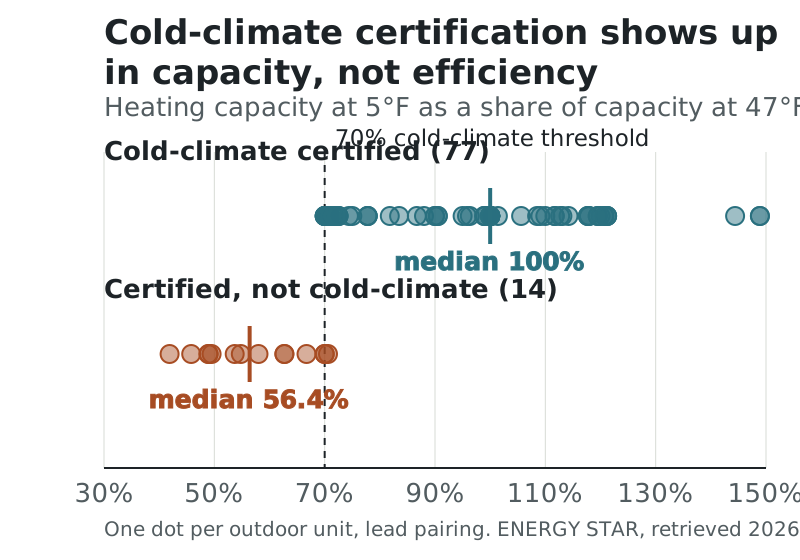
Among the 77 cold-climate certified units on this site, the median lead pairing still delivers 100% of its 47°F capacity at 5°F. Among the units that are ENERGY STAR certified but not cold-climate certified, the 14 that publish a 5°F capacity have a median of 56.4%, and the weakest holds only 41.9%. Both groups clear the efficiency bar for certification. Only one group holds its output when the weather turns, and no SEER2 figure anywhere would have told you which was which.
The two groups barely overlap, which is the point worth taking away from the chart. The question "will this system still heat the house at 5°F" is answered by the capacity columns and the cold-climate flag, not by either seasonal efficiency rating. A unit can post an excellent SEER2, clear the HSPF2 floor comfortably, and still arrive at a design-temperature night with little more than half the output it had at 47°F.
The third rating nobody mentions: EER2
SEER2 vs HSPF2 is the comparison people ask about, but the certification criteria actually name a third figure, and the dataset publishes it for every record. EER2 is the cooling ratio at a single operating point, 95°F outdoors, rather than across a modelled season. ENERGY STAR requires at least 11.0 EER2 for a certified split system alongside the SEER2 and HSPF2 floors.
It is worth a glance for the same reason COP at 5°F is worth a glance on the heating side: a single-point figure cannot be smoothed by mild weather. A system with a strong SEER2 and a weak EER2 is one that does its best work in moderate conditions and is working harder on the hottest afternoons, which is precisely when the grid is strained and electricity may cost the most. Across the units here, published EER2 runs from 11.30 to 18.00, and the ranking is not the same as the SEER2 ranking. The pattern is symmetric: in both modes, the seasonal number tells you about the average hour and the single-point number tells you about the hard hour.
That symmetry is the useful mental model for all four figures. SEER2 and HSPF2 are seasonal averages, one per mode. EER2 and COP at 5°F are single-point measurements at the stressful end of each mode. Capacity at 5°F, in BTU/h, is not an efficiency at all; it is the question of whether the machine can do the job. Each spec table on this site prints all five, because reading only the two seasonal ratings leaves out both of the hard hours and the capacity question entirely.
How to use the two ratings in practice
A sequence that respects what each number can and cannot carry:
- Decide which mode dominates your year. Heating-dominated, cooling-dominated, or genuinely both. This decides whether HSPF2 or SEER2 is your primary filter, and it is a question about your climate and your house, not about any equipment.
- Filter on the primary rating, with a floor rather than a maximum. ENERGY STAR certification already sets 15.2 SEER2 and 7.8 HSPF2 for split systems, so every certified system clears those. Set your own floor above them if you like, but do not chase the top of the range on the rating that does not govern your bill.
- Then read the capacity at 5°F, in BTU/h. Compare it with what the house needs on a design-temperature night. This is a sizing question and it needs a heat-loss calculation, which no rating substitutes for.
- Check cold-climate certification if winter is the point. It is an ENERGY STAR designation applied against the published test data, and it encodes both the efficiency floor and the low-temperature performance floor above.
- Only then run the money. Take the HSPF2 of the specific pairing you are considering, your own electricity and gas prices, and your own annual load, and compute a scenario. A rating is not a bill.
Step five is where most comparisons go wrong, because a rating feels like a cost and is not one. Two systems with the same HSPF2 can consume different amounts of electricity in the same building, depending on installation, controls, head placement, defrost behaviour and how often backup heat runs.
What the certified pairing has to do with all of this
One wrinkle that the SEER2 vs HSPF2 framing can hide: these ratings do not belong to the outdoor unit alone. ENERGY STAR certifies a combination of one outdoor unit with one specific indoor unit, and the same outdoor box matched to a different head often publishes different numbers. In this sample the Carrier 38MPRBQ09AA3 appears with three certified indoor pairings whose SEER2 figures are 28.50, 27.00 and 25.50, and whose HSPF2 figures range from 12.00 to 15.00. That is a wider spread than between many different models.
So a rating quoted for a bare model number is incomplete. The figure applies to the pair, which is why every spec table on this site names the indoor unit beside the figures and prints the ENERGY STAR ID of the exact record the figures came from (ENERGY STAR Certified Heat Pumps dataset).
Where these numbers came from
Every figure in this guide is a published value from the ENERGY STAR Certified Heat Pumps dataset, retrieved on 2026-10-16 through the dataset's own API, for 101 certified pairings across 92 ductless outdoor units. The correlation coefficient, the medians and the ranks are arithmetic on those published values and nothing else. Nothing here was measured, installed or tested by me, and no installed prices appear anywhere on this site because the dataset contains none. The methodology page lists the four places where a judgement is mine rather than the dataset's.
The short form of SEER2 vs HSPF2, then: they are two readings of the same equipment under two different test conditions, they are not convertible, and the one you should read first is decided by your climate rather than by which number is larger on the brochure.
Frequently asked questions
Is SEER2 or HSPF2 more important?
It depends on what the system is for. SEER2 rates cooling efficiency and HSPF2 rates heating efficiency, so in a climate where the system mostly heats, HSPF2 governs the running cost and SEER2 is close to irrelevant. In a cooling-dominated climate the reverse holds. If the heat pump is meant to be the main source of winter heat, read HSPF2 first and then check the published heating capacity at 5°F, because efficiency says nothing about whether the system can still meet the load on a cold night.
What is a good HSPF2 for a heat pump?
ENERGY STAR certification requires at least 7.8 HSPF2 for a split system, and its cold-climate designation requires at least 8.5 HSPF2 for a non-ducted split system. Across the 92 certified ductless outdoor units on this site, published HSPF2 runs from 8.3 to 15.0, so anything above about 10 sits in the upper half of that sample. Those are rating-condition figures, not a prediction of seasonal performance in any particular house.
Can I convert SEER2 to HSPF2?
No. They are measured under different test procedures at different temperatures, one for cooling and one for heating, and nothing in either definition lets you derive the other. Across the certified units on this site the two ratings correlate at r = 0.54, which means knowing one leaves a lot of room for the other to vary. The highest-SEER2 unit in the sample has an HSPF2 of 11.2, while the highest-HSPF2 unit at 15.0 ranks only fourth on SEER2.
How do SEER2 and HSPF2 differ from SEER and HSPF?
The 2 versions come from the M1 test procedure, which the U.S. Department of Energy made the basis of these ratings for equipment manufactured from 2023. M1 raised the external static pressure used in the test to reflect real duct systems, so the same equipment generally posts a lower number under SEER2 than it did under SEER. Old and new ratings are not interchangeable, and comparing a SEER figure from an older brochure with a SEER2 figure from a current one understates the newer system.
What does COP at 5°F add that HSPF2 does not?
COP at 5°F is a single-point measurement: the ratio of heat delivered to electricity drawn at one cold outdoor temperature. HSPF2 is a season-long average built from a standard rating procedure, so it smooths cold hours together with mild ones. For a cold climate the single point is the more pointed question, which is why the ENERGY STAR cold-climate criteria set a floor of 1.75 for COP at 5°F alongside their HSPF2 requirement.
Does a higher HSPF2 always mean a lower heating bill?
Not reliably. HSPF2 is measured at fixed laboratory conditions in a standard rating region, and real consumption depends on your climate, the load, how the system is installed and controlled, and how much backup heat runs. Two systems with the same HSPF2 can use different amounts of electricity in the same building. Use HSPF2 to rank systems against each other, then run a cost scenario with your own prices rather than treating the rating as a bill estimate.