Heat Pump Capacity at 5°F: What the Number Means
Heat pump capacity at 5°F across 91 certified systems: what the published figure is, why retailers print a temperature range instead, and how to use it.
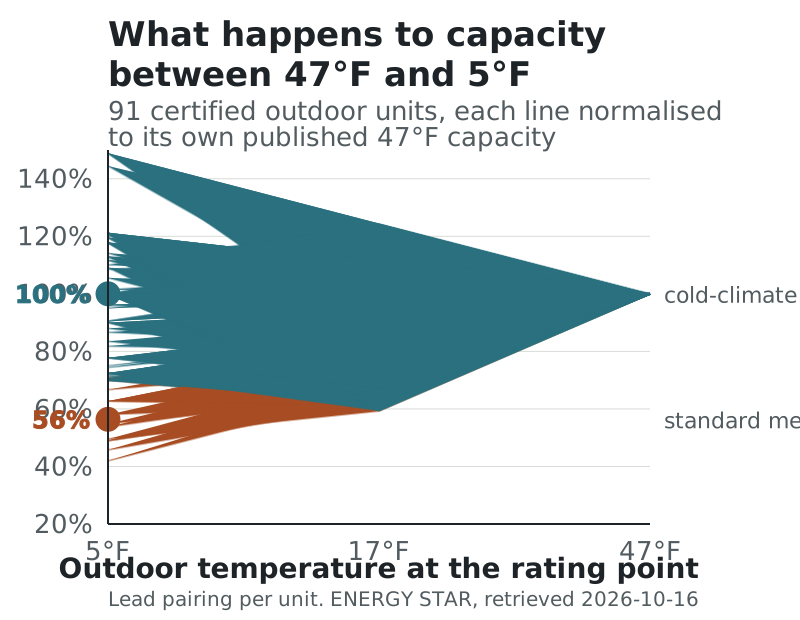
Heat pump capacity at 5°F is the figure that decides whether a mini-split is a heating system or an expensive shoulder-season convenience, and it is the figure hardest to find when you are shopping. Retailers print efficiency ratings, a nominal BTU size and an operating temperature range. The capacity at the bottom of that range is usually missing. This guide sets out what the published number is, how far it varies between systems that look identical, and what it does and does not let you conclude.
Every figure below comes from the ENERGY STAR Certified Heat Pumps dataset, retrieved for this site on 2026-10-16, or from arithmetic on two values in it.
Capacity is not efficiency, and the spec sheet blurs them
A heat pump moves heat from outdoor air into the house. The colder the air, the less heat is in it to move, so output falls as the temperature drops. ENERGY STAR publishes the measured heating capacity at three outdoor temperatures — 47°F, 17°F and 5°F — for each certified pairing of an outdoor unit with an indoor one.
Those three numbers answer a different question from the efficiency ratings next to them. SEER2 and HSPF2 are ratios: heat delivered divided by electricity drawn, over a season. COP at 5°F is the same ratio at one cold test point. Capacity at 5°F is not a ratio at all. It is an amount.
The practical difference is that an efficient system which has run out of capacity does not keep your house warm cheaply. It hands the shortfall to whatever backup heat exists, usually electric resistance elements running at a COP of 1, and the bill goes there instead. Efficiency tells you what the heat costs while the system is making it. Capacity tells you whether it is still making it.
The spread inside one nominal size
Nominal size is the number people shop on. "A 12,000 BTU mini-split" sounds like a specification. At 5°F it is barely a constraint.
Twenty-four of the outdoor units on this site fall in the 12,000 BTU/h nominal class. Their published capacities at 5°F run from 6,600 to 14,700 BTU per hour. The top of that range is 2.2 times the bottom. Two systems a buyer would describe the same way, hang in the same room and size with the same rule of thumb are that far apart on the one night the heating actually matters.
| Outdoor unit | 47°F BTU/h | 5°F BTU/h | Share held | HSPF2 | Cold-climate |
|---|---|---|---|---|---|
| Mitsubishi Electric MUZ-FS12NA*** | 12,300 | 14,700 | 119.5% | 11.1 | Yes |
| Carrier 38MPRBQ12AA3 | 12,000 | 13,700 | 114.2% | 12.0 | Yes |
| Daikin RXTH12AVJU* | 13,500 | 13,500 | 100% | 10.2 | Yes |
| MDV MOX330-12HFN1-MW5W | 12,500 | 11,000 | 88% | 10.0 | Yes |
| Daikin RXF12BVJU* | 13,500 | 9,500 | 70.4% | 10.2 | Yes |
| LG KUSAE121A | 12,000 | 8,400 | 70% | 8.5 | No |
| CanAir C25SCH12H21 | 12,000 | 8,000 | 66.7% | 10.7 | No |
| Daikin RXF12AXVJU | 13,500 | 6,600 | 48.9% | 10.2 | No |
Read the HSPF2 column down that table and the ranking barely tracks the 5°F column at all. The 12.0 HSPF2 unit holds 114% of its warm capacity; the 10.7 holds 67%; the 10.2 appears three times at 100%, 70.4% and 48.9%.
Two Daikins, one rating, 2,900 BTU/h apart
The clearest case in the whole set is a pair from the same brand.
The Daikin RXF12AXVJU publishes SEER2 21.0, EER2 12.5, HSPF2 10.2 and 13,500 BTU/h at 47°F. The Daikin RXF12BVJU* publishes SEER2 21.0, EER2 12.5, HSPF2 10.2 and 13,500 BTU/h at 47°F. On every figure a retailer puts in a product title, they are the same system.
At 17°F they diverge: 8,500 against 9,800 BTU/h. At 5°F the gap is 6,600 against 9,500 — a difference of 2,900 BTU per hour, or 44% more output from the second unit. ENERGY STAR lists the second as meeting its cold-climate criteria and the first as not.
Nothing in the efficiency ratings would have told you. That is the argument for reading the capacity curve, and it is why the curve sits at the top of every certified system page on this site rather than below the ratings table.
What the cold-climate designation is actually testing
ENERGY STAR's cold-climate criteria are a bundle, not a single test. For a non-ducted split system the key product criteria require:
- at least 8.5 HSPF2 and at least 15.2 SEER2;
- a COP of at least 1.75 at 5°F, measured under the Appendix M1 H42 test;
- at least 70% of the 47°F heating capacity still available at 5°F.
A system can clear two of those and miss the third, and the dataset lets you see which. Two examples, both traceable:
Missing the capacity test. The Daikin RXF12AXVJU above publishes a COP at 5°F of 2.32, comfortably over the 1.75 floor, and an HSPF2 of 10.2, over the 8.5 floor. It holds 48.9% of its 47°F capacity at 5°F. It is not cold-climate certified.
Missing the COP test. The LG KUSAE121A and the LG KUSAH121A both publish 12,000 BTU/h at 47°F, 8,000 at 17°F and 8,400 at 5°F — identical capacity curves, both at 70% retention, both on the line. The KUSAH121A publishes a COP at 5°F of 1.80 and HSPF2 9.0, and carries the cold-climate designation. The KUSAE121A publishes a COP at 5°F of 1.70 and HSPF2 8.5, and does not. Five hundredths of a COP point below the floor.
Across the 91 units on this site that publish a 5°F capacity, the designation separates the population cleanly on capacity: not one of the 77 cold-climate certified units falls below 70%, while the units without it have a median of 56.4% and the weakest holds 41.9%. Three units without the designation — the LG KUSAE091A, KUSAE121A and KUSAE181A — sit at 70.6%, 70% and 70%, on or over the capacity line but short somewhere else in the bundle.
The useful consequence: the cold-climate badge is a reliable floor and a poor ceiling. It tells you a system holds at least 70% of its capacity. It does not distinguish the one that holds exactly 70% from the one that holds 119%, and those are very different machines on a February morning.
Twenty-five records publish more heat at 5°F than at 47°F
This looks like an error and is not one, at least not one we are entitled to correct.
Twenty-five of the 91 units publish a higher capacity at 5°F than at 47°F. The highest is the Fujitsu AOU9RLFF: 9,000 BTU/h at 47°F and 13,400 at 5°F, which is 148.9%. The dataset carries no description for heating_capacity_at_47_f_btu_h, heating_capacity_at_17_f_btu_h, heating_capacity_at_5_f_btu_h or cop_at_5_f in its own column metadata, so it does not say whether any given figure is a maximum output or a rated output at that temperature.
A plausible reading is that a variable-speed system has been rated at its maximum output in the cold and at some other operating point at 47°F. That reading is not in the source, so this site does not assert it. What it does instead is print the figures as published, flag where retention exceeds 100%, and say on the methodology page that the comparison between a unit's three capacities is not necessarily a comparison of like with like.
What this rules out is any reading of these numbers as "the system makes more heat when it is colder". Physics does not work that way. It is a rating-procedure artefact, and the honest response is to treat an over-100% figure as evidence that the three points were not all measured at the same operating condition, and to lean on the 5°F figure in absolute BTU/h rather than on the percentage.
Why the figure is missing from the pages you were reading
Retailer listings are where most people meet a model number, and they publish a different set of numbers.
Checked on 2026-10-17, a retailer product page for the Daikin RXF09AXVJU and its matched FTXF09AXVJU head publishes SEER2 21.0, EER2 12.5, HSPF2 10.2, a cooling capacity "up to 11,200 BTU", a heating capacity "up to 10,000 BTU" with no temperature attached, a heating operating range of 5–65°F, and a price. It does not publish a capacity at 5°F, and it does not say whether the system carries the ENERGY STAR cold-climate designation.
Those two omissions compound in a specific way. A "5–65°F heating operating range" looks like a cold-weather claim — the number 5 is right there. It is a statement that the equipment will run at 5°F, not a statement of how much heat it makes. The same model's ENERGY STAR record publishes 10,000 BTU/h at 47°F and 4,900 BTU/h at 5°F, a retention of 49%, and no cold-climate designation. The "up to 10,000 BTU" in the listing is the 47°F figure; at the bottom of the advertised operating range the system is making less than half of it.
Review and buying-guide articles are not much better on this point, though they fail differently. A widely ranked roundup of cold-climate mini-splits, read on 2026-10-17, tabulates SEER and HSPF rather than SEER2 and HSPF2 — the metrics the Department of Energy superseded for equipment manufactured from 2023 — gives maximum heating capacity at temperatures between −12°F and −31°F drawn from manufacturer literature rather than a named dataset, cites no source or retrieval date for those figures, and does not state cold-climate certification status for any model. Another, from a large consumer energy site, lists only a minimum operating temperature and an "up to" HSPF2 for five product lines, with no 5°F capacity at all.
None of that is fabricated. It is just not the number the question needs.
How to use the figure once you have it
Three things it is good for, and one it is not.
Comparing two certified systems. This is what it does best. Both figures come from the same procedure, so the comparison is apples to apples even though neither is a prediction. The register of certified systems sorts and filters on it, and the cold-climate certified subset is one click.
Judging how much backup heat a design leans on. Capacity at 5°F against a design load tells you roughly where the system stops covering it alone. It will not tell you precisely, because the load and the capacity curve both move and the published figures are three points rather than a function, but it is the right starting number for the conversation.
Sanity-checking a quote. If a proposal sizes a system on nominal BTU alone and the house is in a cold climate, the 5°F figures for the models proposed are a fair question to put back.
What it is not good for is sizing. Matching capacity to a house needs a room-by-room heat-loss calculation, and a published rating is not one. Nor is any of this a prediction: SEER2, EER2, HSPF2 and the COP at 5°F are results of a standard rating procedure at fixed laboratory temperatures and airflow, and the same system will behave differently in Boston and in Atlanta. The running-cost calculator on this site is explicit about that; it converts prices you type into a scenario and refuses to call it a forecast.
One system in the set publishes no 5°F capacity at all: the Mitsubishi Electric MUZ-GL15NAH*** record carries 18,000 BTU/h at 47°F and 12,100 at 17°F, and nothing at 5°F, so its pages print "not published" rather than an interpolation. A blank in the source stays a blank here. For the ratings that sit beside it, read SEER2 vs HSPF2; for every figure's provenance, the methodology page names the dataset, the API, the retrieval date and the record ID behind each one. Heat pump capacity at 5°F is a single published number, and the reason it is worth hunting down is that almost nothing else on a spec sheet can stand in for it.
Sources
- ENERGY STAR Certified Heat Pumps, U.S. Environmental Protection Agency, Socrata dataset
83eb-xbyy. Retrieved 2026-10-16. All capacity, COP, SEER2, EER2 and HSPF2 figures and all cold-climate designations. - ENERGY STAR, Air-Source Heat Pumps Key Product Criteria. Read 2026-10-17 for the cold-climate HSPF2, SEER2, COP at 5°F and percentage-of-47°F-capacity requirements for non-ducted split systems.
- Retailer product listing for the Daikin FTXF09AXVJU / RXF09AXVJU system, read 2026-10-17, for the published specification set described above. Quoted as an example of what a retail listing does and does not carry; no price or availability from it is reproduced here.
- Cold-climate mini-split roundups from two third-party publishers, read 2026-10-17, for the metrics and sourcing described in this guide.
Frequently asked questions
What does heating capacity at 5°F mean?
It is the heat output, in BTU per hour, that a certified system produced at a 5°F outdoor temperature during the standard rating test. It is a capacity figure, not an efficiency figure: it says how much heat the system can make, not how much electricity it used making it. ENERGY STAR publishes it alongside the 47°F and 17°F figures for each certified pairing, and the dataset's own column metadata does not state whether each figure is a maximum or a rated output.
Is a 5°F to 65°F operating range the same as capacity at 5°F?
No, and the difference matters. An operating range says the equipment will run at that temperature. A capacity figure says how much heat it makes there. A retailer listing for the Daikin RXF09AXVJU, fetched on 2026-10-17, gives a heating operating range of 5–65°F and a heating capacity of 'up to 10,000 BTU' with no temperature attached. Its ENERGY STAR record publishes 10,000 BTU/h at 47°F and 4,900 BTU/h at 5°F — the 'up to' figure is the warm one.
How much capacity should a heat pump keep at 5°F?
ENERGY STAR's cold-climate criteria require at least 70% of the 47°F capacity to remain at 5°F, together with a COP of at least 1.75 at 5°F and at least 8.5 HSPF2 for a non-ducted split system. Across the 91 certified outdoor units on this site that publish a 5°F capacity, none of the 77 cold-climate certified ones falls below that 70% line, and the units without the designation have a median of 56.4%.
Why do some systems publish more capacity at 5°F than at 47°F?
Twenty-five of the 91 units on this site do, the highest at 148.9% of its 47°F figure. The dataset carries no description for any of the three capacity columns, so it does not say whether a given figure is a maximum output or a rated output at that temperature. A variable-speed system rated at maximum output when it is cold and at a different operating point at 47°F would produce exactly this pattern. The figures are printed here as published and not corrected.
Does a higher HSPF2 mean more heat at 5°F?
No. Two Daikin units on this site publish the same 10.2 HSPF2 and the same 13,500 BTU/h at 47°F, and then 6,600 and 9,500 BTU/h at 5°F — a 2,900 BTU/h difference with identical efficiency ratings. Efficiency and cold-weather capacity are separate questions, which is why each system page here plots the capacity curve before it shows any rating.
What does capacity at 5°F not tell me?
It does not tell you what your house needs. Matching a capacity to a load requires a room-by-room heat-loss calculation, which no published rating substitutes for. It is also a rating-condition result measured at fixed laboratory temperatures and airflow, not a prediction for any particular winter, house or installation. It tells you how two certified systems compare on one cold-weather test point, which is a narrower and more answerable question.