What Is a Good HSPF2 Rating? What 92 Certified Units Show
What is a good HSPF2 rating? The legal floor is 7.5 and ENERGY STAR's is 7.8, but 92 certified mini-splits here have a median of 10.2. What each means.
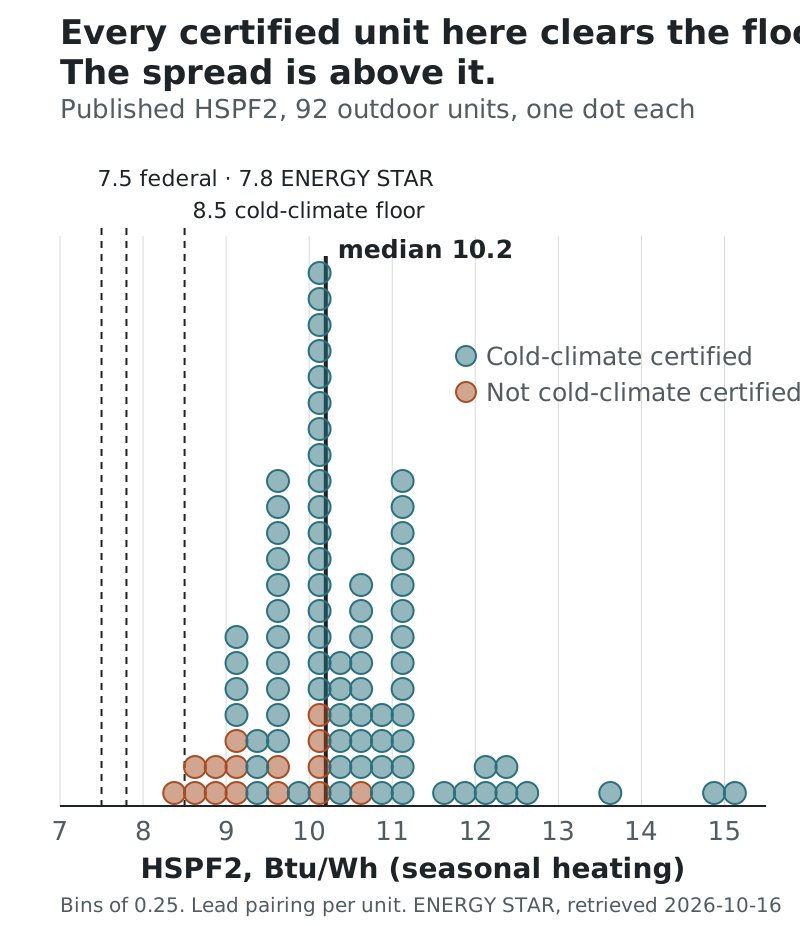
What is a good HSPF2 rating? The legal minimum for a split-system heat pump is 7.5, ENERGY STAR asks for 7.8, and its cold-climate designation asks a ductless system for 8.5. Every one of the 92 certified ductless outdoor units on this site clears all three, and the middle of the group is 10.2, so a "good" rating in practice sits well above any floor you will see quoted.
That is the short answer, and it is only half of one. HSPF2 tells you how efficiently a heat pump makes heat across a modelled season. It does not tell you how much heat the system can still make on the coldest night, and the data shows those two things drift apart more than most buying guides admit. I pulled the published HSPF2 for every unit on this site from the ENERGY STAR dataset to show where the floors sit, where real certified systems land, and what the rating cannot answer.
Four thresholds, and how many of 92 units clear them
The numbers people quote as "the" good HSPF2 are actually separate floors set by separate bodies for separate purposes.
| HSPF2 | What it is | Source | Units here at or above it |
|---|---|---|---|
| 7.5 | Federal minimum, split-system heat pumps made from 2023 | 10 CFR 430.32(c)(5) | 92 of 92 |
| 7.8 | ENERGY STAR floor, split systems | ENERGY STAR key product criteria | 92 of 92 |
| 8.5 | ENERGY STAR cold-climate floor, non-ducted split systems | ENERGY STAR key product criteria | 91 of 92 |
| 10.0 | Not a rule: a round number near this site's median | This site's data | 63 of 92 |
| 11.0 | Not a rule | This site's data | 23 of 92 |
| 12.0 | Not a rule | This site's data | 8 of 92 |
The first three rows are rules. The federal standard sets 7.5 HSPF2 for split-system heat pumps and 6.7 for single-package units. The ENERGY STAR key product criteria set 7.8 for split systems and 7.2 for single-package equipment, and the cold-climate designation adds a higher floor: 8.5 for non-ducted split systems, 8.1 for ducted split systems and single-package equipment.
Because every unit on this site is already ENERGY STAR certified, the first two floors filter out nothing here. They tell you a system is legal and certified. They do not separate a good certified system from an average one. The three rows below them do that work, and they are not rules from anyone; they are counts against round numbers so you can see the shape of the group.
Why the "good HSPF2" numbers online disagree
If you have read three pages on this question, you have probably seen three different answers. Explainers ranking for it on 2026-10-17 variously gave 8, 8.5, and both 7.5 and 8.5 as the bar to aim for, sometimes on the same page.
Most of that disagreement traces to three numbers being flattened into one:
- 7.5 versus 7.8. The federal minimum and the ENERGY STAR floor for split systems are 0.3 apart. Pages that call 7.5 "the ENERGY STAR level" are quoting the legal minimum instead.
- 7.8 versus 8.1 versus 8.5. ENERGY STAR's plain floor is 7.8. Its cold-climate designation asks 8.1 of ducted systems and 8.5 of non-ducted ones. A page that says "ENERGY STAR requires 8.5" is describing the cold-climate floor for a ductless system, which is a stricter test than certification itself.
- HSPF versus HSPF2. The older HSPF rating came from a different test procedure and generally reads higher for the same equipment. Thresholds quoted from before 2023 belong to that scale, and the conversion factors different sites publish do not agree with each other. On this site every figure is HSPF2 as published, and no old HSPF figure is converted.
None of these pages is wrong about its own number. They are answering slightly different questions. The table above keeps them apart.
Where 92 certified mini-splits actually land
Here is the distribution behind the figure. Each value is the published HSPF2 of the pairing a unit's page leads with, which on this site is always that unit's highest published HSPF2.
| Point in the group | HSPF2 |
|---|---|
| Lowest | 8.3 |
| 10th percentile | 9.0 |
| 25th percentile | 9.6 |
| Median | 10.2 |
| 75th percentile | 10.9 |
| 90th percentile | 11.6 |
| Highest | 15.0 |
Read it this way. Half the units publish 10.2 or more. A quarter publish 10.9 or more. Only eight publish 12.0 or more, and the three above 13 are the Carrier 38MPRBQ09AA3 at 15.0, the Midea 37MAHAQ06AA3 at 14.8 and the LG KUSAL091A at 13.5. At the bottom, the lowest figure in the set is 8.3, from the LG KUSAE241A.
One honest limit on all of this. These 92 units are a deliberate sample, chosen by brand and model series so each page is a distinct outdoor unit, out of 17,874 mini or multi split records the dataset held at retrieval. The percentiles describe this group. They are a fair picture of where certified ductless systems from the 14 brand names in the set sit, not a census of every mini-split sold. The methodology page sets out how the sample was drawn.
Cold-climate units rate higher, but the groups overlap
Split the 92 by ENERGY STAR's cold-climate designation and the medians separate.
| Group | Units | Lowest | Median | Highest |
|---|---|---|---|---|
| Cold-climate certified | 77 | 9.0 | 10.4 | 15.0 |
| Certified, not cold-climate | 15 | 8.3 | 9.1 | 10.7 |
The medians are 1.3 apart, and that is the expected direction. What the table also shows is the overlap. The best-rated unit without the designation, the CanAir C25SCH12H21, publishes 10.7 HSPF2, which is above the cold-climate median. The lowest-rated units with the designation, including the LG KUSAH121A, publish 9.0.
The reason is that the designation is not mainly about HSPF2. Above the 8.5 floor, it turns on two tests at 5°F: a COP of at least 1.75, and at least 70% of the 47°F heating capacity still available. The CanAir publishes 12,000 BTU/h at 47°F and 8,000 at 5°F, which is 66.7%, under the 70% line. The LG KUSAH121A publishes 12,000 and 8,400, which is exactly 70%, with a COP at 5°F of 1.80. On HSPF2 the CanAir is 1.7 points ahead. On the question the cold-climate badge asks, it falls short and the LG passes.
Same HSPF2, very different machine at 5°F
This is the part a single "good HSPF2" number hides. Nine outdoor units on this site publish exactly the group median, 10.2. Here is what each of them publishes at 5°F.
| Outdoor unit | 47°F BTU/h | 5°F BTU/h | Share at 5°F | Cold-climate |
|---|---|---|---|---|
| Daikin RXTH12AVJU* | 13,500 | 13,500 | 100% | Yes |
| Daikin RXTH09AVJU* | 10,900 | 10,900 | 100% | Yes |
| LG KUSAL241A | 24,000 | 21,600 | 90% | Yes |
| TOSOT TW09HXP2A1DO | 10,500 | 9,100 | 86.7% | Yes |
| Mitsubishi Electric MUZ-GS09NAH*** | 10,900 | 7,900 | 72.5% | Yes |
| Daikin RXF09BVJU* | 10,900 | 7,700 | 70.6% | Yes |
| Daikin RXF12BVJU* | 13,500 | 9,500 | 70.4% | Yes |
| Daikin RXF09AXVJU | 10,000 | 4,900 | 49% | No |
| Daikin RXF12AXVJU | 13,500 | 6,600 | 48.9% | No |
Take the first and last rows. The Daikin RXTH12AVJU* and the Daikin RXF12AXVJU publish the same HSPF2 and the same 13,500 BTU/h at 47°F. At 5°F one publishes 13,500 and the other 6,600. That is more than double the output from two systems with an identical seasonal heating rating.
Across the whole set the pattern holds loosely rather than tightly. Over the 91 units that publish both figures, HSPF2 and the 5°F capacity share correlate at 0.46, and HSPF2 and COP at 5°F correlate at 0.32. Higher-rated systems do tend to hold more heat in the cold, but the scatter is wide enough that the rating alone is a poor guide to the coldest night. The 5°F capacity guide goes deeper on that figure and on why some records publish more heat at 5°F than at 47°F.
Bigger systems rate lower in this sample
One more thing to know before comparing ratings across sizes. Grouped by nominal size class, which is this site's label rather than a dataset field, the median HSPF2 falls as systems get bigger.
| Nominal class | Units | Median HSPF2 | Range |
|---|---|---|---|
| 6,000 BTU/h | 3 | 12.0 | 10.8 – 14.8 |
| 9,000 BTU/h | 30 | 10.2 | 8.7 – 13.5 |
| 12,000 BTU/h | 24 | 10.2 | 8.5 – 15.0 |
| 15,000 BTU/h | 12 | 10.45 | 9.4 – 11.2 |
| 18,000 BTU/h | 14 | 10.0 | 8.9 – 11.2 |
| 24,000 BTU/h | 8 | 9.3 | 8.3 – 10.2 |
The one remaining unit, the Lennox 3WPD036S6S-1P* in the 30,000 BTU/h class, publishes 9.0.
The 6,000 and 24,000 rows have too few units to lean on, but the practical point stands: a 24,000 BTU/h system at 10.0 is above its class median here, while a 9,000 BTU/h system at 10.0 is slightly below its own. If you are choosing between sizes, compare each candidate with others of the same size, not with a single number. The register of certified systems filters by capacity class for exactly this.
What the number means in plain terms
HSPF2 is total space heating delivered over a modelled heating season, in BTU, divided by the electricity the system draws over that season, in watt-hours. ENERGY STAR's definition specifies the season as climate region IV in the federal test procedure, which is why the figure describes the equipment rather than any particular house.
Two conversions make it easier to feel what a point of HSPF2 is worth. Dividing by 3.41214 gives the implied seasonal coefficient of performance, the heat delivered per unit of electricity. And because the rating is BTU per watt-hour, delivering one million BTU of heat takes 1,000,000 ÷ HSPF2 watt-hours.
| HSPF2 | Implied seasonal COP | kWh per million BTU delivered |
|---|---|---|
| 7.5 | 2.20 | 133.3 |
| 8.5 | 2.49 | 117.6 |
| 9.0 | 2.64 | 111.1 |
| 10.2 | 2.99 | 98.0 |
| 10.9 | 3.19 | 91.7 |
| 12.0 | 3.52 | 83.3 |
| 15.0 | 4.40 | 66.7 |
Moving from 9.0 to 11.0 cuts the rated electricity for the same heat by about 18%. That is real, and it compounds over a heating season. But it is a ratio under rating conditions. Your consumption depends on your climate, your house, the installation, the controls and how often backup heat runs, and two systems with the same HSPF2 can use different amounts of electricity in the same building. The running-cost calculator turns a rating into a scenario with your own load and prices, and prints every formula it uses.
How to judge whether a rating is good for you
A sequence that uses HSPF2 for what it is good at and nothing more:
- Confirm the number is HSPF2. If a listing or an older brochure gives HSPF, it is on the older test scale and will read higher. Look for the HSPF2 on the certification record for the specific indoor and outdoor pair, because the same outdoor unit can publish different ratings with different heads.
- Treat 7.5, 7.8 and 8.5 as gates, not goals. Any certified ductless system has already passed the first two. If winter heating is the job, the cold-climate designation is the gate worth checking, and the cold-climate certified subset is one filter away.
- Compare within a size class. Above the gates, rank candidates of the same nominal size against each other. On this site, 10.2 is the middle for 9,000 and 12,000 BTU/h units and 9.3 for 24,000.
- Then read the capacity at 5°F before deciding. Two systems at the same HSPF2 can differ by more than double at 5°F. If the heat pump is your main heat source, that figure decides whether it covers the coldest nights on its own. The SEER2 vs HSPF2 guide explains where HSPF2 sits among the other ratings.
- Only then price it. Run the specific pairing's HSPF2 against your own prices and load rather than treating the rating as a bill.
So, what is a good HSPF2 rating? Anything certified has already cleared the floors; on this group of 92, around 10.2 is typical and 10.9 or above is the top quarter, but the number is only good for your house if the capacity at 5°F is good too.
Sources
- ENERGY STAR Certified Heat Pumps, U.S. Environmental Protection Agency, Socrata dataset
83eb-xbyy. Retrieved 2026-10-16. Every HSPF2, capacity, COP and cold-climate figure for individual units, and every count, percentile, median and correlation, which are arithmetic on those published values. - ENERGY STAR, Heat Pump Equipment Key Product Criteria. Read 2026-10-17 for the 7.8 and 7.2 HSPF2 floors, the 8.5 and 8.1 cold-climate floors, the 5°F COP and capacity requirements, and the definition of HSPF2.
- 10 CFR 430.32(c)(5), Electronic Code of Federal Regulations. Read 2026-10-17 for the 7.5 and 6.7 HSPF2 federal minimums for heat pumps manufactured on or after January 1, 2023.
- Explainers ranking for "what is a good HSPF2 rating", read 2026-10-17, for the thresholds described in the section on why answers disagree. Characterised, not quoted.
Frequently asked questions
What is the minimum HSPF2 for a heat pump?
For split-system heat pumps manufactured on or after January 1, 2023, the federal minimum is 7.5 HSPF2 under 10 CFR 430.32(c)(5). Single-package heat pumps have a lower minimum of 6.7. ENERGY STAR sets its own higher floor of 7.8 HSPF2 for split systems, and its cold-climate designation asks for 8.5 HSPF2 from non-ducted split systems and 8.1 from ducted ones.
Is 10 HSPF2 good?
Among the 92 certified ductless outdoor units on this site, 10.0 sits a little below the median of 10.2: 63 of the 92 publish 10.0 or higher. It is comfortably above every regulatory and ENERGY STAR floor. Whether it is good for your house depends less on that number than on whether the system still has enough heating capacity at your coldest temperatures, which HSPF2 does not report.
What HSPF2 do cold-climate heat pumps have?
The 77 cold-climate certified units on this site publish HSPF2 from 9.0 to 15.0, with a median of 10.4. The 15 units without the designation run from 8.3 to 10.7, with a median of 9.1. The ranges overlap: a non-certified unit at 10.7 out-rates several certified ones, because the designation is decided mainly by low-temperature performance at 5°F rather than by the seasonal rating.
Can I compare an HSPF rating with an HSPF2 rating?
Not directly. HSPF2 comes from the newer DOE Appendix M1 test procedure, which generally produces a lower number than the older HSPF test for the same equipment. Published rules of thumb for converting between them disagree with each other, so the reliable comparison is HSPF2 against HSPF2, read from the certification record for the specific indoor and outdoor pairing.
Does a higher HSPF2 mean more heat on a cold night?
No. HSPF2 is a seasonal efficiency ratio, not a capacity figure. Nine units on this site publish exactly 10.2 HSPF2, and their heating capacity at 5°F ranges from 48.9% to 100% of their 47°F capacity. Across 91 units that publish both figures, HSPF2 and the 5°F capacity share correlate at only 0.46.
How much less electricity does a higher HSPF2 use?
By definition, delivering one million BTU of heat takes 1,000,000 ÷ HSPF2 watt-hours under rating conditions: about 111 kWh at 9.0 HSPF2 and about 91 kWh at 11.0, roughly 18% less. That is a ratio from the rating procedure, not a prediction for any house, climate or installation.