Heat Pump Balance Point: Find It From Published Capacity
The heat pump balance point is where capacity meets the house's heat loss. How to estimate it from ENERGY STAR capacity figures, and what happens below it.
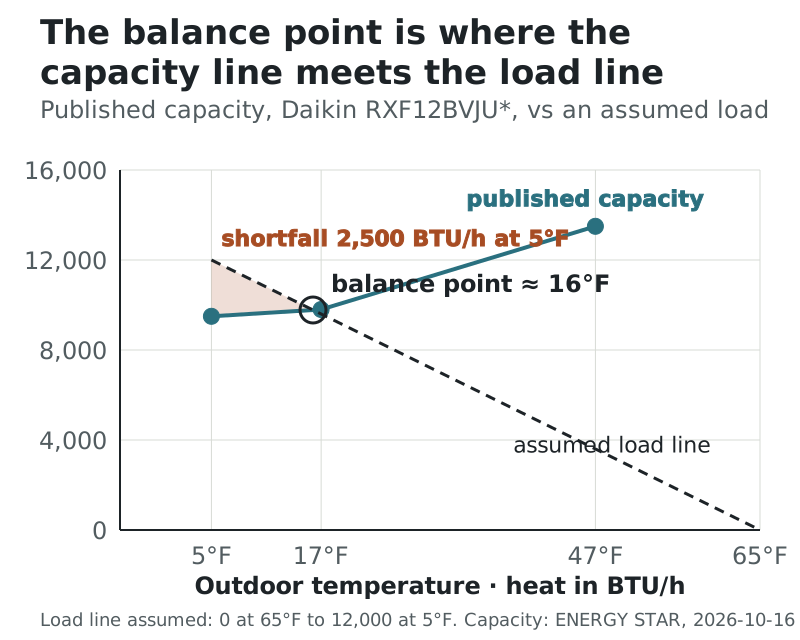
The heat pump balance point is the outdoor temperature at which a heat pump's heating capacity exactly matches the house's heat loss. Above it, the heat pump carries the whole load on its own. Below it, the house needs heat the heat pump cannot make, and that heat comes from backup — usually electric resistance — or does not come at all. You can estimate it by drawing two lines, the system's published capacity against outdoor temperature and the house's heat loss against outdoor temperature, and finding where they cross.
ENERGY STAR publishes three points on the first line for every certified pairing. The second line belongs to your house. This guide shows how to put them together, works an example with a certified mini-split, and covers the economic version of the same idea.
The two lines behind the heat pump balance point
The capacity line falls as it gets colder, because colder outdoor air holds less heat for the heat pump to move. The ENERGY STAR Certified Heat Pumps dataset publishes heating capacity at 47°F, 17°F and 5°F for each certified pairing. Three points, not a curve: joining them with straight lines is a simplification, and this site says so on every chart.
The load line rises as it gets colder, because a house loses heat faster the bigger the gap between indoors and outdoors. It is roughly a straight line from zero at the temperature where the house needs no heat to its design load at its design temperature. ACCA's Manual J, which ACCA describes as the national ANSI-recognized standard for producing equipment sizing loads, is how the design load is calculated.
Where they cross is the thermal balance point. Building-science writer Allison Bailes puts it plainly: at a certain temperature, the capacity is equal to the load, and below it the home needs supplemental heat.
A worked heat pump balance point
Take one certified system and one assumed load. The system is the Daikin RXF12BVJU*, a 12,000 BTU/h class mini-split with the ENERGY STAR cold-climate designation. Its lead pairing publishes:
| Outdoor temperature | Published heating capacity |
|---|---|
| 47°F | 13,500 BTU/h |
| 17°F | 9,800 BTU/h |
| 5°F | 9,500 BTU/h |
The load is an assumption for illustration, not a calculation for any real house: zero at 65°F rising in a straight line to 12,000 BTU/h at 5°F, which is 200 BTU/h for every degree below 65°F. At 17°F that load is 9,600 BTU/h; at 5°F, 12,000.
At 17°F the system publishes 9,800 against a load of 9,600, so it still covers it. At 5°F it publishes 9,500 against 12,000. Somewhere between, the lines cross. With straight-line joins the crossing is at about 16°F. That is the balance point for this system against this load, and the hero chart above draws it.
Below 16°F, the shortfall grows: 2,500 BTU/h at 5°F in this example.
What happens below the balance point
The heat pump keeps running at full output and something else supplies the rest. In most ductless installations that is electric resistance heat, at a COP of 1.
The cost of that is easy to put a number on with published figures. At 5°F the RXF12BVJU* publishes a COP of 2.10. Delivering its 9,500 BTU/h at that COP draws about 1,326 watts. The 2,500 BTU/h shortfall from resistance heat draws about 733 watts more. Together they deliver 12,000 BTU/h for about 2,058 watts — an effective COP of about 1.71 for the whole system at that hour, below the heat pump's own 2.10.
Compare its sibling, the Daikin RXF12AXVJU. It publishes the same 13,500 BTU/h at 47°F, then 8,500 at 17°F and 6,600 at 5°F, with a higher COP at 5°F of 2.32. Against the same assumed load its balance point moves up to about 20°F, and at 5°F the shortfall is 5,400 BTU/h. The heat pump draws about 834 watts and the resistance heat about 1,583: about 2,416 watts in all, an effective COP of about 1.46. The unit with the better COP at 5°F produces the worse system result, because it runs out of capacity sooner.
All of this is rating-condition arithmetic on an assumed load. It shows the mechanism; it does not predict a bill.
Twenty-four units, one load line
The same assumed load — zero at 65°F, 12,000 BTU/h at 5°F — can be run against every unit in the 12,000 BTU/h class to show how far the balance point moves with equipment alone. Straight lines between the three published points, as above:
| Outdoor unit | 47°F | 17°F | 5°F | Estimated balance point | Shortfall at 5°F |
|---|---|---|---|---|---|
| Carrier 38MPRBQ12AA3 | 12,000 | 10,400 | 13,700 | below 5°F | none |
| Daikin RXTH12AVJU* | 13,500 | 11,800 | 13,500 | below 5°F | none |
| Fujitsu AOU12RLFF | 12,000 | 10,600 | 13,400 | below 5°F | none |
| DELLA 048-C-TPH-12K2V-25S-OUT | 12,000 | 14,000 | 12,000 | below 5°F | none |
| MDV MOX330-12HFN1-MW5W | 12,500 | 9,500 | 11,000 | about 17°F | 1,000 BTU/h |
| Daikin RXF12BVJU* | 13,500 | 9,800 | 9,500 | about 16°F | 2,500 BTU/h |
| LG KUSAH121A | 12,000 | 8,000 | 8,400 | about 22°F | 3,600 BTU/h |
| CanAir C25SCH12H21 | 12,000 | 9,000 | 8,000 | about 19°F | 4,000 BTU/h |
| Daikin RXF12AXVJU | 13,500 | 8,500 | 6,600 | about 20°F | 5,400 BTU/h |
Capacities are in BTU/h, from each unit's lead pairing. Six of the 24 units in the class publish enough heat at all three points to cover this load, so for them the published figures can only say the balance point is below 5°F, if there is one at all. Five more publish 12,000 BTU/h or more at 5°F but less than the 9,600 BTU/h this load needs at 17°F, which is the pattern discussed in the next section. For the remaining 13, the estimated crossing runs from about 15°F to about 22°F.
Two caveats travel with the table. The load line is invented for illustration; a real house's line comes from a load calculation and will differ. And for several units the straight-line join between 47°F and 17°F crosses the load line before the 5°F figure recovers, which is the artefact described in the next section. The table is a demonstration of method, not a ranking.
When three published points mislead
Straight lines between three points are an approximation, and one pattern in the dataset breaks it. Twenty-five of the 91 units here that publish a 5°F capacity publish more heat at 5°F than at 47°F, and many publish less at 17°F than at either.
The Mitsubishi Electric MUZ-FS12NA*** is an example: 12,300 BTU/h at 47°F, 8,400 at 17°F and 14,700 at 5°F. Against the same assumed load, straight lines would show a shortfall between about 13°F and 21°F and none at 5°F. That is not a physical description of the machine. The dataset's column metadata does not say whether each capacity is a maximum or a rated output, so the three figures may not be measured at the same operating condition. The capacity at 5°F guide discusses this in detail. For units like this, treat a balance-point estimate as rough and ask for the manufacturer's full performance data at more temperatures.
The economic balance point
A second balance point matters if the house has a gas or oil furnace as backup. It is the outdoor temperature below which heat from the heat pump costs more per BTU than heat from the furnace.
The comparison is simple once both are expressed per million BTU delivered:
- Furnace: gas price ÷ AFUE × 10 therms. At $1.50 per therm and 80% AFUE, $18.75.
- Heat pump: electricity price × 293.07 kWh ÷ COP. At 17.30 cents per kWh, the U.S. 2025 average residential price reported by the EIA, $50.70 ÷ COP.
They are equal when the COP is about 2.70. Above that COP the heat pump is cheaper per BTU at those prices; below it, the furnace is. Among the 91 units here that publish a COP at 5°F, only the Carrier 38MPRBQ18AA3 publishes more than 2.70. So at these prices, almost every unit here makes more expensive heat than the furnace at 5°F, while the seasonal COP implied by the median HSPF2 of 10.2, about 2.99, is above the break-even.
The economic balance point therefore sits somewhere between the mild hours, where the heat pump wins, and 5°F, where the furnace usually does at these prices. Where exactly depends on your prices and the system's COP between the rating points, which the dataset does not publish. The running-cost calculator shows the seasonal version of this comparison with your own prices and prints the break-even electricity price.
Getting your own load line
The load line needs two points: the outdoor temperature at which the house needs no heat, and the heat loss at the design temperature.
The design-temperature load is what a Manual J calculation produces. It accounts for the house's construction, windows, air leakage and the local design conditions, which is why ACCA describes it as the standard for producing equipment sizing loads.
The zero-load temperature is sometimes called the balance point of the building, to make things confusing. It is the outdoor temperature at which internal gains from people, appliances and sun cover the house's losses. The worked example here assumes 65°F as a round figure; a well-insulated house with large internal gains may need no heat until it is colder outside.
A shortcut from fuel use gives a rough check rather than a replacement. If you know last winter's delivered heat, from gas use multiplied by 100,000 and by the furnace AFUE as the mini split electricity cost guide shows, it tells you the total heat over a season. Turning that into a peak load needs heating degree-day data for your location, which this site does not hold, and the result is approximate.
Backup heat, in a ductless installation
Many ductless installations have no built-in backup at all. A ducted heat pump usually has electric resistance strips in the air handler that switch on automatically below the balance point. A single-zone mini split often relies on whatever heating the room already had: baseboard, a boiler and radiators, or a furnace serving the rest of the house.
That changes what the balance point means in practice. Where the existing system is electric baseboard, the shortfall costs the same as resistance strips would, at a COP of 1. Where it is a gas or oil system, the comparison is the economic balance point above. Where there is nothing, the shortfall shows up as a cooler room.
Bailes's article also cautions against switching to emergency heat just because it is cold, because resistance heat is far less efficient than the heat pump running. Below the balance point, the heat pump keeps supplying most of the heat; the backup only covers the difference.
Moving the balance point
Reduce the load. Air sealing and insulation flatten the load line, and every BTU/h removed at the design temperature lowers the crossing.
Choose more capacity at low temperatures, not just more nominal size. The two Daikins above share a nominal size and a 47°F figure; the 5°F figure is what moves the balance point. The register of certified systems lists capacity at 5°F for every unit, and the mini split sizing guide shows how to compare it with a load.
Be wary of oversizing for cooling. ACCA's Manual S sets size limits to prevent short cycling. A unit chosen only to push the balance point down may be far too large for the summer.
What the balance point cannot tell you
It is one temperature, and real winters are made of many. How much the shortfall costs over a season depends on how many hours fall below the balance point, which depends on your climate. It also depends on the load line, which this guide assumed and which a real calculation replaces. And it cannot be estimated below 5°F from the dataset alone, because no published figure goes lower.
What the heat pump balance point does give you is a single, checkable number that joins the equipment and the house — the temperature below which the published capacity stops being enough on its own.
Sources
- ENERGY STAR Certified Heat Pumps, U.S. Environmental Protection Agency, Socrata dataset
83eb-xbyy. Retrieved 2026-10-16. Every capacity and COP figure for individual units, and every count, which are arithmetic on those published values. - Allison Bailes, "Finding Balance – Heat Pump Heating Load vs. Capacity", Energy Vanguard, 2011-03-10. Read 2026-10-17 for the description of the balance point and the typical ranges quoted.
- Air Conditioning Contractors of America, Manual J and Manual S. Read 2026-10-17 for their descriptions as the residential load calculation standard and the equipment selection procedure.
- U.S. Energy Information Administration, Electricity explained: Factors affecting electricity prices. Read 2026-10-17 for the 2025 average residential price of 17.30 cents per kWh.
- ENERGY STAR, Heat Pump Equipment Key Product Criteria. Read 2026-10-17 for the definition of COP.
Frequently asked questions
What is a heat pump balance point?
It is the outdoor temperature at which the heat pump's heating capacity equals the house's heat loss. Above it, the heat pump can carry the whole load. Below it, the house loses heat faster than the heat pump can supply it, and the difference has to come from another source or the indoor temperature falls. It is a property of one house and one system together, not of the equipment alone.
What is a typical heat pump balance point?
There is no equipment-only answer, because it depends on the house's heat loss. Building-science writer Allison Bailes, in an article read on 2026-10-17, describes a worked example at 22°F and says many homes fall in the mid-30s°F. In the illustrative example in this guide, a certified mini-split against an assumed load crosses at about 16°F. A larger or better-insulated load line moves it.
What is the difference between the thermal and economic balance point?
The thermal balance point is where capacity meets load. The economic balance point is the outdoor temperature below which heat from the heat pump costs more per BTU than heat from the alternative, which depends on your fuel prices. At 17.3 cents per kWh and $1.50 per therm in an 80% AFUE furnace, the heat pump is cheaper per BTU whenever its COP is above about 2.70.
How do I lower my heat pump balance point?
Either reduce the load or raise the capacity at low temperatures. Air sealing and insulation flatten the load line. Choosing a system that holds more of its capacity at 5°F raises the capacity line where it matters: two Daikin units on this site publish the same 13,500 BTU/h at 47°F and 6,600 versus 9,500 BTU/h at 5°F, which moves the balance point in this guide's example from about 20°F to about 16°F.
Can I find a balance point below 5°F from ENERGY STAR data?
No. The dataset publishes heating capacity at 47°F, 17°F and 5°F only. If capacity and load have not crossed by 5°F, all the published figures can say is that the balance point is below 5°F. Extending the line further would be an extrapolation the source does not support.