What Size Mini Split Do I Need? Read the 5°F Figure
What size mini split do I need? Square-foot charts size for cooling. For heat, compare your load with published capacity at 5°F, as 92 units show.
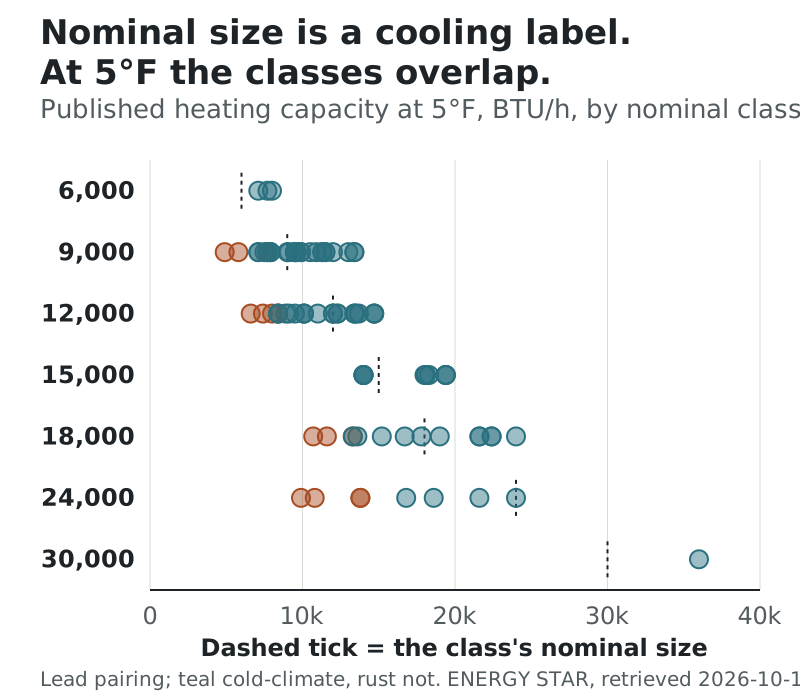
What size mini split do I need? For cooling, a square-foot chart gets you close: ENERGY STAR's room air conditioner chart puts 450 to 550 square feet at 12,000 BTU per hour. For heating, the answer is a different number — the room's heat loss at your coldest design temperature — compared against the heating capacity a system publishes at that temperature, not the nominal size on the box. Across 92 certified ductless outdoor units on this site, two systems sold under the same nominal size can differ by more than double at 5°F.
This guide covers how the nominal size is set, what the square-foot charts actually describe, what a proper load calculation adds, and how to read the published capacity figures once you have a load.
Mini split size is a cooling number
Mini splits are sold by nominal size: 9,000, 12,000, 18,000 BTU per hour and so on. On this site the nominal class is assigned from the highest rated cooling capacity among a unit's certified pairings, as the methodology page records, and that matches how the market uses the label.
Heating capacity is a separate set of numbers. The ENERGY STAR Certified Heat Pumps dataset publishes three for each certified pairing: at 47°F, 17°F and 5°F outdoors. Every unit on this site publishes at least as much heat at 47°F as its rated cooling capacity, and 81 of 92 publish more. At 5°F the picture changes completely.
| Nominal class | Units | Capacity at 47°F, BTU/h | Capacity at 5°F, BTU/h |
|---|---|---|---|
| 6,000 | 3 | 7,000 – 7,100 | 7,100 – 8,000 |
| 9,000 | 30 | 9,000 – 12,000 | 4,900 – 13,400 |
| 12,000 | 24 | 12,000 – 14,400 | 6,600 – 14,700 |
| 15,000 | 12 | 14,000 – 18,300 | 14,000 – 19,400 |
| 18,000 | 14 | 18,000 – 21,600 | 10,700 – 24,000 |
| 24,000 | 8 | 22,000 – 25,000 | 9,900 – 24,000 |
One 15,000 BTU/h unit publishes no 5°F figure and is left out of that column. The hero chart above plots every unit: the 9,000 and 12,000 classes overlap almost entirely at 5°F, and the weakest 24,000 BTU/h unit here publishes less heat at 5°F than 25 of the 54 units in the two smaller classes.
What the square-foot charts actually describe
The most widely quoted sizing chart is ENERGY STAR's own, published on its room air conditioner page. An extract:
| Area to be cooled, sq ft | Capacity needed, BTU/h |
|---|---|
| 350 up to 400 | 9,000 |
| 400 up to 450 | 10,000 |
| 450 up to 550 | 12,000 |
| 550 up to 700 | 14,000 |
| 700 up to 1,000 | 18,000 |
| 1,400 up to 1,500 | 24,000 |
The page states that the capacities assume an 8-foot ceiling and gives four adjustments: reduce by 10% for a heavily shaded room, increase by 10% for a very sunny one, add 600 BTU for each regular occupant beyond two, and add 4,000 BTU for a kitchen.
Two things to notice. It is a chart for room air conditioners, and it is a chart for cooling. It contains no information about insulation, windows, air leakage or outdoor design temperature, which are what drive a heating load. It is a reasonable starting point for a cooling-only purchase and the wrong tool for sizing heat in a cold climate.
How to size a mini split for heating
The procedure has three steps, and only the last one involves equipment.
1. Get the heating load at your design temperature. The design temperature is a cold outdoor temperature for your location that the system is meant to handle. The load is how many BTU per hour the room or house loses at that temperature. ACCA's Manual J is the procedure for calculating it; ACCA describes it as the national ANSI-recognized standard for producing equipment sizing loads, and notes that national building codes and most state and local jurisdictions require it.
2. Pick the published capacity point nearest that temperature. If your design temperature is near 5°F, use the 5°F capacity. If it is nearer 17°F, the 17°F figure is the closer comparison, with the 5°F figure as a margin. Do not compare a cold-weather load with the 47°F figure, which is the one retailers usually present as "the" heating capacity.
3. Check the cooling load too. ACCA's Manual S, the equipment selection procedure, sets size limits to prevent short cycling, and covers sizing tolerances for variable-capacity heat pumps. A unit chosen for heat that is far too large for the room's cooling load is a trade-off to make knowingly.
A worked mini split sizing example
Suppose a Manual J puts a room's heating load at 10,000 BTU/h at a 5°F design temperature, and its cooling load at about 9,000 BTU/h. Nominal size would point at a 9,000 or 12,000 BTU/h unit. The published figures sort them out:
| Outdoor unit | Nominal class | 47°F, BTU/h | 5°F, BTU/h | Covers 10,000 at 5°F? |
|---|---|---|---|---|
| Fujitsu AOU9RLFF | 9,000 | 9,000 | 13,400 | Yes |
| Mitsubishi Electric MUZ-FS09NA*** | 9,000 | 9,600 | 11,300 | Yes |
| Daikin RXF09BVJU* | 9,000 | 10,900 | 7,700 | No, 2,300 short |
| Daikin RXF12BVJU* | 12,000 | 13,500 | 9,500 | No, 500 short |
| Daikin RXF12AXVJU | 12,000 | 13,500 | 6,600 | No, 3,400 short |
Ten of the 30 units in the 9,000 BTU/h class publish 10,000 BTU/h or more at 5°F, and so do 15 of the 24 in the 12,000 class. The bigger box does not automatically win. A 9,000 BTU/h unit with a strong cold-weather curve can be the better match for this room than a 12,000 BTU/h unit with a weak one, while staying closer to the cooling load.
The comparison holds only at the rating condition. These are laboratory figures at fixed temperatures and airflow; they rank systems against each other and do not predict any installation.
The 17°F figure and moderate design temperatures
Not every house needs to plan for 5°F. Where the design temperature is milder, the 17°F capacity is the closer comparison, and it does not always sit neatly between the other two figures.
| Nominal class | Units | Capacity at 17°F, BTU/h | Units publishing at least the nominal size at 17°F |
|---|---|---|---|
| 9,000 | 30 | 5,700 – 12,000 | 6 |
| 12,000 | 24 | 7,600 – 14,000 | 1 |
| 15,000 | 12 | 8,700 – 17,800 | 1 |
| 18,000 | 14 | 11,600 – 20,800 | 2 |
| 24,000 | 8 | 13,500 – 21,000 | 0 |
At 17°F, most units publish less than their nominal size, and some publish less at 17°F than at 5°F. The Mitsubishi Electric MUZ-FS12NA*** is an example: 12,300 BTU/h at 47°F, 8,400 at 17°F and 14,700 at 5°F. The dataset's column metadata does not say whether each figure is a maximum or a rated output, so the three points may not describe the same operating condition. For sizing, the cautious reading is to compare your load with the lower of the 17°F and 5°F figures, and to ask the manufacturer for its full extended performance data if the two disagree sharply.
Single-zone sizing and multi-zone systems
Everything on this site is a single-zone pairing: one outdoor unit matched with one indoor unit, which is how the dataset publishes a complete set of ratings. The dataset's coverage note records that outdoor units certified without one matched indoor unit, which is how multi-zone systems appear, are excluded here because a matched-system spec table for them would be incomplete.
Sizing a multi-zone system adds steps a single-zone comparison does not. Each room needs its own load, each indoor head its own capacity, and the outdoor unit has to cover the combined load at the design temperature. The published figures on this site cannot answer that, and a contractor's Manual J and Manual S work, room by room, is the place it gets answered.
Mini split BTU calculator shortcuts that mislead
BTU per square foot rules. A single multiplier cannot account for the difference between a tight new addition and a leaky older room in the same climate.
Sizing on the 47°F figure. It is the largest of the three published heating figures for most units and the one least relevant to a cold night. Among the 14 certified units here without the cold-climate designation that publish both figures, the 5°F capacity ranges from 41.9% to 70.6% of the 47°F one.
Assuming the cold-climate badge solves sizing. The designation guarantees at least 70% of the 47°F capacity at 5°F. It says nothing about whether that capacity matches your load; the cold-climate criteria guide shows how wide the range above the floor is.
Reading an operating range as capacity. "Heats down to 5°F" says the unit will run there, not how much heat it makes. The capacity at 5°F guide shows a retail listing where the gap between the two was more than half the advertised heating figure.
Questions to put to a contractor
A sizing proposal is easier to judge with a few specific questions, each of which the published figures help answer:
- What heating load did you calculate, and at what design temperature? A number with a temperature attached means a calculation was done. A square-foot figure means it was not.
- Which indoor and outdoor model numbers, exactly? Ratings belong to the certified pairing. With both model numbers, the ENERGY STAR record can be looked up and every figure checked.
- What does that pairing publish at 5°F and 17°F? If the proposal sizes on the nominal figure, the published capacity at the cold end is a fair question to put back.
- How does it compare with the cooling load? If the unit is much bigger than the cooling load to cover heating, that trade-off should be stated.
- What happens below the balance point? Every system has one; the answer should name the backup and roughly when it runs.
None of these require the contractor to share a price or reveal anything commercial. They are all questions about the load and the equipment's published figures, and a proposal that can answer them is one that has been sized rather than guessed.
Room by room, not house by house
A ductless system heats the room its indoor head is in, and the rooms around it only as far as air moves through doorways. That is why a single nominal figure for a whole house is the wrong frame for most mini split installations. A Manual J calculation produces loads per room as well as for the house, and those room loads are what a single-zone head should be matched to. A large open-plan space may suit one head; a house of closed rooms may need several, or a different approach.
When the load is larger than the capacity
Below the temperature at which capacity and load meet, something else has to make up the difference. That temperature is the balance point, and the balance point guide shows how to estimate it from the three published capacity figures and a load line. If the shortfall falls to electric resistance heat at a COP of 1, it costs far more per BTU than the heat pump does, which is why sizing and running cost cannot really be separated.
Finding units by capacity at 5°F
The register of certified systems lists every outdoor unit with its published 5°F capacity and filters by size class, so the 12,000 BTU/h class or the cold-climate subset is one link away. Each model page plots the three published capacities as a curve and lists every certified indoor pairing, because the figures belong to the pair rather than the outdoor unit alone.
What size mini split do I need, then? The one whose published heating capacity at your design temperature covers your calculated load, at a nominal size that does not badly overshoot the cooling load, and that is a question the box label alone cannot answer.
Sources
- ENERGY STAR Certified Heat Pumps, U.S. Environmental Protection Agency, Socrata dataset
83eb-xbyy. Retrieved 2026-10-16. Every capacity figure, size-class range and count, which are arithmetic on those published values. - ENERGY STAR, Room Air Conditioners product page. Read 2026-10-17 for the cooling capacity chart, its 8-foot ceiling assumption and its four adjustments.
- Air Conditioning Contractors of America, Manual J. Read 2026-10-17 for its description as the ANSI-recognized residential load calculation standard and its code status.
- Air Conditioning Contractors of America, Manual S. Read 2026-10-17 for its description as the equipment selection procedure and its size limits to prevent short cycling.
Frequently asked questions
What size mini split do I need for 500 square feet?
For cooling, ENERGY STAR's room air conditioner chart, which assumes an 8-foot ceiling, puts 450 to 550 square feet at 12,000 BTU per hour, with adjustments for sun, shade, occupants and kitchens. That chart is for room air conditioners and for cooling only. For heating, square footage is not enough: you need the room's heat loss at your design temperature, and then a unit whose published capacity at your coldest temperatures covers it.
Is a 12,000 BTU mini split always 12,000 BTU of heat?
No. The nominal size is essentially a cooling label. Among the 24 units in the 12,000 BTU/h class on this site, published heating capacity at 47°F runs from 12,000 to 14,400 BTU/h, and at 5°F from 6,600 to 14,700 BTU/h. Only 11 of the 24 publish 12,000 BTU/h or more at 5°F.
Can I just buy a bigger mini split to be safe?
Oversizing has costs. ACCA's Manual S sets size limits specifically to prevent short cycling, and a unit that is too large for its cooling load cycles more and removes less moisture. A better route is to compare published 5°F capacity between units of the same nominal size: some 9,000 BTU/h class units on this site publish more heat at 5°F than some 12,000 BTU/h class units.
What is a Manual J and do I need one?
Manual J is ACCA's residential load calculation, which ACCA describes as the national ANSI-recognized standard for producing equipment sizing loads, required by national building codes and most state and local jurisdictions. It works out heating and cooling loads from the building's construction, windows, air leakage and local design conditions. Manual S is the companion procedure for choosing equipment against those loads.
Which capacity figure should I compare with my heating load?
The one nearest your design temperature. ENERGY STAR publishes heating capacity at 47°F, 17°F and 5°F for each certified pairing. If your design temperature is near 5°F, the 5°F figure is the honest comparison; the 47°F figure, which is the one retailers usually quote as the heating capacity, will overstate what the unit makes on your coldest nights. Below 5°F, the dataset has no figure at all.