Mini Split Electricity Cost: How to Work It Out
Mini split electricity cost comes from three numbers: the heat or cooling needed, the rating, and your price per kWh. The method, worked with real ratings.
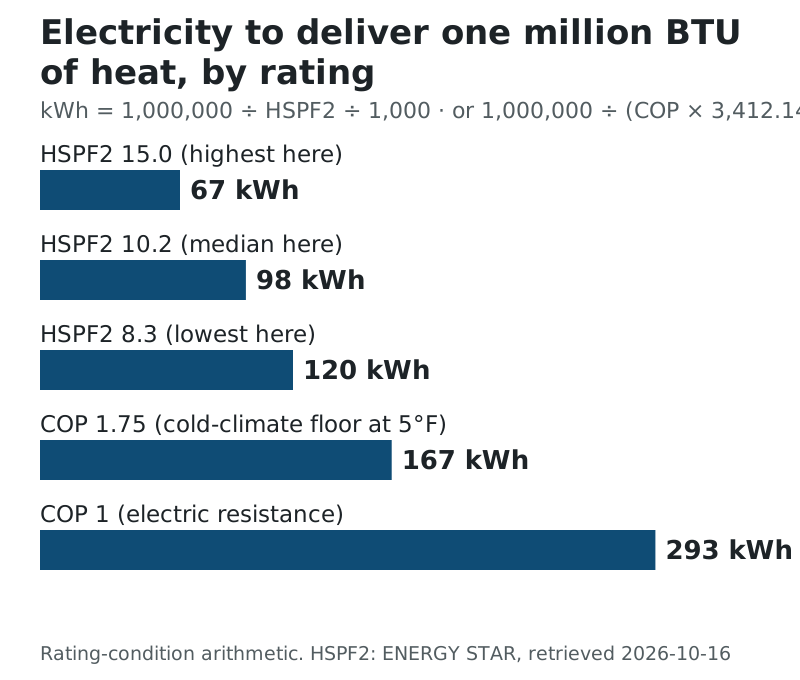
Mini split electricity cost comes down to three numbers: how much heating or cooling the house actually needs over a period, how efficiently the system delivers it, and what you pay per kilowatt-hour. The efficiency side is published — HSPF2 for heating and SEER2 for cooling on every certified pairing — and the price is on your bill. The missing number is usually the load, and this guide shows how to get it, then works the full calculation through with published ratings from 92 certified ductless systems.
There is no single answer to "how much does a mini split cost to run", because the same unit costs different amounts in different houses. What is fixed is the method, and the method is short.
The three inputs to mini split electricity cost
1. The load. For heating, this is the total heat delivered to the house over the season, in BTU. For cooling, the total heat removed. It belongs to the house and the climate, not the equipment, and no spec sheet contains it.
2. The efficiency rating. HSPF2 is total heat delivered over a modelled season divided by the electricity used, in BTU per watt-hour, as defined in ENERGY STAR's key product criteria. SEER2 is the cooling equivalent. Both are published per certified pairing in the ENERGY STAR Certified Heat Pumps dataset.
3. The electricity price. Your marginal price per kWh, including delivery charges, from your own bill. As a reference, the U.S. Energy Information Administration reports an average residential price of 17.30 cents per kWh for 2025, with all-sector state averages ranging from 8.20 cents in North Dakota to 35.72 cents in Hawaii. That spread is the main reason a national running-cost figure is not useful.
The formula that joins them:
kWh = load in BTU ÷ rating ÷ 1,000 cost = kWh × price per kWh
Because HSPF2 and SEER2 are both in BTU per watt-hour, dividing the load by the rating gives watt-hours, and dividing by 1,000 gives kilowatt-hours.
Where to get the heating load
Most households do not know their seasonal heat load in BTU, but many can derive it from a past fuel bill. If the house is heated by gas now:
delivered heat (BTU) = therms burned × 100,000 × furnace AFUE
A therm is 100,000 BTU by definition, and AFUE is the share of the fuel's energy the furnace delivers as heat. 600 therms through an 80% AFUE furnace is 600 × 100,000 × 0.80 = 48 million BTU delivered. That figure is the load the heat pump would have to replace, and it is exactly the input the site's running-cost calculator asks for. The calculator shows this conversion with your numbers in it.
Two cautions. Gas bills often include water heating and cooking, which are not space heating; strip them out if you can. And a single year's fuel use reflects that year's weather; a mild winter understates the load.
The rigorous route is a room-by-room load calculation. ACCA describes its Manual J as the national ANSI-recognized standard for producing equipment sizing loads, and most jurisdictions require it. A Manual J gives peak loads for sizing rather than seasonal energy, but it is the starting point for any serious estimate.
Mini split heating cost, worked from published HSPF2
With a load of 48 million BTU and the EIA 2025 average residential price of 17.30 cents per kWh:
| HSPF2 | Where it sits in this set | Electricity, kWh | Cost at 17.30¢ |
|---|---|---|---|
| 15.0 | Highest | 3,200 | about $554 |
| 12.0 | Top decile | 4,000 | about $692 |
| 10.2 | Median | 4,706 | about $814 |
| 9.1 | Median of units without the cold-climate designation | 5,275 | about $913 |
| 8.3 | Lowest | 5,783 | about $1,000 |
| COP 1 equivalent | Electric resistance | 14,067 | about $2,434 |
Every row is arithmetic on a published rating and two stated assumptions. The hero chart above shows the same comparison per million BTU delivered: about 67 kWh at the top of this set, 98 at the median, 120 at the bottom, against 293 for resistance heat.
The spread between the best and worst certified system here, about $446 a year in this scenario, is real but smaller than the difference between any heat pump and resistance heat. It is also smaller than the effect of your electricity price: the same median system at 30 cents per kWh would cost about $1,412.
How much the electricity price moves the answer
Hold the system and the load fixed and change only the price, and the result moves more than it does between any two certified systems. For the same 48 million BTU delivered:
| Electricity price | Median system, HSPF2 10.2 | Electric resistance, COP 1 |
|---|---|---|
| 8.20¢ (lowest 2025 all-sector state average, North Dakota) | about $386 | about $1,153 |
| 12.0¢ | about $565 | about $1,688 |
| 17.30¢ (2025 U.S. residential average) | about $814 | about $2,434 |
| 25.0¢ | about $1,177 | about $3,517 |
| 35.72¢ (highest 2025 all-sector state average, Hawaii) | about $1,681 | about $5,025 |
The two state figures are EIA averages across all customer types, not residential prices, and are shown only to mark the width of the range. The 12 and 25 cent rows are round numbers, not published averages. Your own bill is the only price that belongs in a real scenario, and the marginal price — what one more kilowatt-hour costs, including delivery — is the right one to use, not the bill total divided by usage if the bill has a fixed charge.
The cost of an hour at 5°F
A seasonal figure hides what the coldest hours cost. Combining a published 5°F capacity and COP with a price gives the cost of one hour at full output at that test point:
| Outdoor unit | 5°F capacity, BTU/h | COP at 5°F | Draw | Per hour at 17.30¢ |
|---|---|---|---|---|
| Carrier 38MPRBQ18AA3 | 24,000 | 2.89 | about 2,434 W | about 42¢ |
| Mitsubishi Electric MUZ-FS12NA*** | 14,700 | 2.30 | about 1,873 W | about 32¢ |
| LG KUSAH121A | 8,400 | 1.80 | about 1,368 W | about 24¢ |
The per-hour figure is the price of heat at that output, not a forecast of an hour's cost: a variable-speed system often runs below full output, and if the house needs more heat than the system makes, the backup heat adds its own cost on top. Per million BTU delivered at 5°F, those three units work out to about $17.54, $22.04 and $28.17 at 17.30 cents; electric resistance works out to about $50.70.
Monthly and seasonal patterns
Annual cost is not spread evenly. A heating load concentrates in the coldest months, and those are also the months when a heat pump runs at its lowest COP. The seasonal HSPF2 already accounts for that inside the rating procedure's modelled climate, but it does not show it month by month, and no published rating does. If your utility sends monthly usage history, the months with the biggest gas bills are the months a heat pump's electricity use would rise most.
For a rough split of an annual heating figure into months, the share of last year's gas use in each month is a better guide than an even twelfth, since it reflects your own house and your own weather. It is still an approximation: the heat pump's efficiency falls in the cold months, so its share of annual electricity in those months will be somewhat higher than the gas share.
Mini split power consumption at a moment in time
Annual cost answers one question. "How many watts does it draw?" is another, and two published figures answer it at their test points.
Cooling at 95°F, from EER2. EER2 is cooling output in BTU per hour divided by power in watts at a single operating point; manufacturer Trane describes the test condition as 95°F outdoors, 80°F indoors and 50% humidity. Watts = cooling capacity ÷ EER2.
| Outdoor unit | Rated cooling, BTU/h | EER2 | Draw at 95°F |
|---|---|---|---|
| Midea 37MAHAQ06AA3 | 6,000 | 18.0 | about 333 W |
| Median of the 12,000 BTU/h class | 12,000 | 13.05 | about 920 W |
| Daikin RXTH12AVJU* | 12,000 | 11.3 | about 1,062 W |
| DELLA 048-C-TP-23K2V-23S-OUT | 23,000 | 11.7 | about 1,966 W |
Heating at 5°F, from COP. Watts = heat output ÷ (COP × 3.41214). The Mitsubishi Electric MUZ-FS12NA*** publishes 14,700 BTU/h at a COP of 2.3 at 5°F, about 1,873 watts; the LG KUSAH121A publishes 8,400 BTU/h at 1.8, about 1,368 watts. The heat pump COP guide covers this conversion in full.
These are draws at a rating point with the unit delivering its rated output. A variable-speed mini split spends most hours well below that, so multiplying any of these by 24 hours does not give daily consumption.
Cooling cost: the same method with SEER2
For cooling, swap HSPF2 for SEER2 and the heating load for a cooling load. Per 10 million BTU of cooling delivered, the lowest SEER2 on this site, 18.0, uses about 556 kWh; the median, 22.85, about 438 kWh; the highest, 30.0, about 333 kWh. At 17.30 cents, that is roughly $96, $76 and $58.
In most of the places where a mini split is bought mainly for heat, cooling loads are far smaller than heating loads, which is why the SEER2 vs HSPF2 guide argues that HSPF2 governs the bill in a heating-dominated climate.
What the calculation leaves out
Backup heat. HSPF2 assumes the heat pump meets the modelled load. If it cannot on the coldest days, the shortfall goes to another source, typically electric resistance at a COP of 1. The balance point guide shows how to see where that starts from a published capacity.
Installation and controls. The U.S. Department of Energy's Energy Saver guidance notes that systems with correct refrigerant charge and airflow generally perform close to their rated figures, which also means installation affects whether they do.
Your climate. HSPF2 is calculated for one climate region in the rating procedure. The same system will post a different seasonal efficiency in a colder or milder place.
Equipment and installation prices. The dataset contains none, and this site does not estimate them. Only operating cost is covered here.
A worked example, start to finish
Putting the steps together for one hypothetical household, with every input labelled:
- Load. Last winter's gas bills show 600 therms used for space heating through a furnace with an 80% AFUE. Delivered heat: 600 × 100,000 × 0.80 = 48,000,000 BTU.
- System. The candidate is a certified pairing publishing 10.2 HSPF2, the median on this site.
- Electricity. 48,000,000 ÷ 10.2 ÷ 1,000 = about 4,706 kWh.
- Price. The household's bill shows a marginal price of 17.30 cents per kWh, the same as the 2025 national average for this example.
- Cost. 4,706 × $0.173 = about $814 for the season.
- Sanity check. At a COP of 1, the same heat would take about 14,067 kWh, or about $2,434. The heat pump scenario uses about a third of that electricity, consistent with a seasonal COP of about 2.99.
Each of those inputs is a number the household can check. The calculator does steps 1, 3 and 5 automatically and prints the arithmetic, so a mistake in any input is visible rather than hidden.
Comparing against a gas furnace
The same load lets you put a furnace beside the heat pump. Furnace gas = load ÷ AFUE ÷ 100,000 therms. For 48 million BTU at 80% AFUE that is 600 therms; at $1.50 per therm, $900.
Holding everything else fixed, the electricity price at which the heat pump scenario costs the same is the furnace cost divided by the heat pump's kWh. For HSPF2 10.2, that is $900 ÷ 4,706 kWh, about 19.1 cents per kWh. The calculator prints both break-even prices with your inputs, and its link reopens the exact scenario so it can be shared.
Mini split electricity cost is not a property of the equipment. It is your load, divided by a published rating, multiplied by your price, and each of those three numbers is worth getting right before trusting the answer.
Sources
- ENERGY STAR Certified Heat Pumps, U.S. Environmental Protection Agency, Socrata dataset
83eb-xbyy. Retrieved 2026-10-16. Every HSPF2, SEER2, EER2, COP and capacity figure for individual units, and every median and range, which are arithmetic on those published values. - ENERGY STAR, Heat Pump Equipment Key Product Criteria. Read 2026-10-17 for the definitions of HSPF2, SEER2, EER2 and COP.
- U.S. Energy Information Administration, Electricity explained: Factors affecting electricity prices. Read 2026-10-17 for the 2025 average residential price of 17.30 cents per kWh and the all-sector state range.
- Trane, glossary entry "What is EER?". Read 2026-10-17 for the EER2 test conditions.
- Air Conditioning Contractors of America, Manual J. Read 2026-10-17 for its description as the ANSI-recognized residential load calculation standard.
- U.S. Department of Energy, Energy Saver: Air-Source Heat Pumps. Read 2026-10-17 for the statement on refrigerant charge, airflow and rated performance.
Frequently asked questions
How much electricity does a 12,000 BTU mini split use?
At the rating point there is a direct answer. EER2 is cooling output in BTU per hour divided by power in watts at 95°F outdoors, so a 12,000 BTU/h unit with the median EER2 of the 12,000 BTU/h class on this site, 13.05, draws about 920 watts at that point. In heating at 5°F, the Mitsubishi Electric MUZ-FS12NA*** publishes 14,700 BTU/h at a COP of 2.3, about 1,873 watts. Across a season, consumption depends on how much heat or cooling the house needs, which no rating states.
What is the formula for mini split heating cost?
Annual heating kWh equals the heat the house needs in BTU divided by HSPF2 and then by 1,000. Multiply by your price per kWh for the cost. For 48 million BTU at HSPF2 10.2, that is about 4,706 kWh; at the U.S. 2025 average residential price of 17.30 cents per kWh reported by the EIA, about $814. Both inputs are yours to replace, and the result is a rating-condition scenario, not a bill.
How do I find out how much heat my house needs?
The calculator on this site accepts last year's gas use in therms and your furnace AFUE, and converts them into delivered heat: therms times 100,000 times AFUE. 600 therms through an 80% furnace is 48 million BTU. If you heat with something else, a fuel bill can be converted the same way using that fuel's energy content and the appliance efficiency. A room-by-room load calculation is the rigorous route.
Does a mini split cost more to run in very cold weather?
Yes, for two reasons. The house needs more heat, and the heat pump makes it less efficiently: across the 91 certified units on this site the median COP at 5°F is 1.90, against a median seasonal COP of about 2.99 implied by HSPF2. If the system cannot meet the load at all, the shortfall goes to backup heat, typically electric resistance at a COP of 1, which takes about 293 kWh per million BTU.
Is it cheaper to run a mini split or a gas furnace?
It depends on your two prices and the two efficiencies. With 48 million BTU delivered, an 80% AFUE furnace at $1.50 per therm costs $900, and a heat pump at HSPF2 10.2 breaks even with it at about 19.1 cents per kWh. Below that electricity price the heat pump scenario is cheaper; above it, the furnace is. The running-cost calculator on this site does this arithmetic with your own numbers and shows every step.
Can I estimate cost from the BTU rating on the box?
No. The nominal size is a capacity, the rate at which the unit can move heat when running flat out. Cost depends on how much heat is actually moved over the year and on the efficiency of moving it. A 12,000 BTU/h unit in a small, well-insulated room may spend most hours far below its rated output.