ENERGY STAR Cold Climate Heat Pump Criteria, Unit by Unit
The ENERGY STAR cold climate heat pump criteria are five tests, not one. Which ones 15 certified mini-splits miss, and what the badge does not tell you.
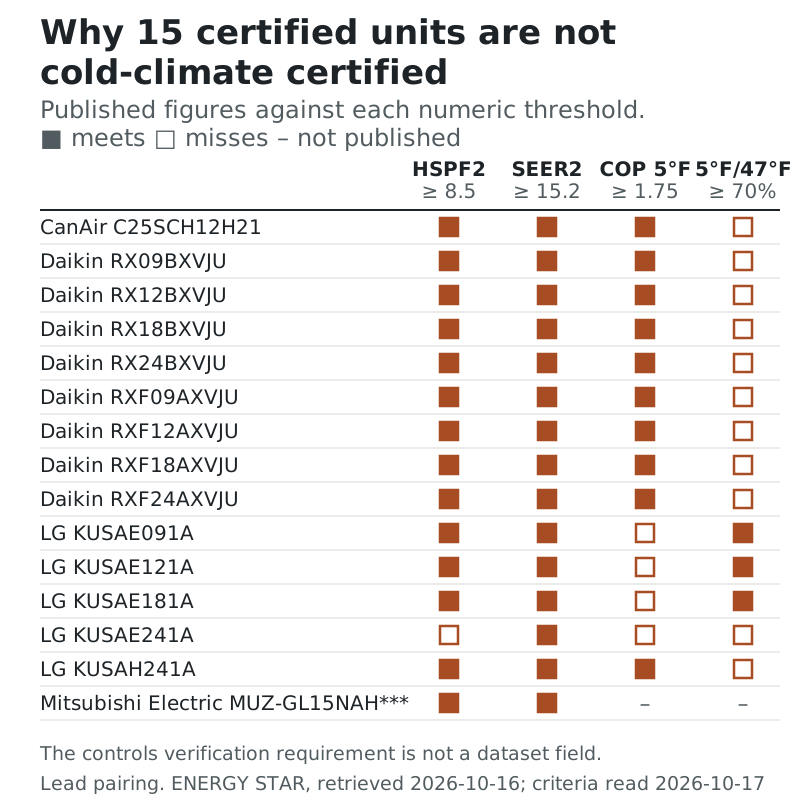
The ENERGY STAR cold climate heat pump criteria are a bundle of five requirements, and a certified system has to clear every one of them to carry the designation. Two are efficiency floors, HSPF2 and SEER2. Three are low-temperature tests at 5°F: a minimum COP, a minimum share of capacity retained, and a check that the unit's own controls deliver that performance. Of the 92 certified ductless outdoor units on this site, 77 carry the designation and 15 do not, and the published figures show exactly which test each of the 15 misses.
This guide lays out the criteria as ENERGY STAR publishes them, then walks through the units that fall short, because the pattern of failures says more about what the badge means than the criteria list does on its own.
The five requirements, as published
The ENERGY STAR key product criteria, read on 2026-10-17, set these thresholds for the cold-climate designation:
| Requirement | Split, non-ducted | Split, ducted | Single package |
|---|---|---|---|
| HSPF2 | at least 8.5 | at least 8.1 | at least 8.1 |
| SEER2 | at least 15.2 | at least 15.2 | at least 15.2 |
| COP at 5°F (Appendix M1 H42 test) | at least 1.75 | at least 1.75 | at least 1.75 |
| Capacity at 5°F ÷ capacity at 47°F | at least 70% | at least 70% | at least 70% |
| Controls verification procedure | required | required | required |
The criteria page states that all three low-ambient requirements must be met. The controls verification procedure, or CVP, confirms that the 5°F performance is what the unit's native controls produce, rather than a setting forced for the test; the ENERGY STAR cold-climate CVP or a DOE-adopted one is accepted.
For context, these sit above two lower floors. Plain ENERGY STAR certification for a split system asks for 7.8 HSPF2, 15.2 SEER2 and 11.0 EER2. The federal minimum under 10 CFR 430.32(c)(5) for split-system heat pumps manufactured from January 1, 2023 is 14.3 SEER2 and 7.5 HSPF2. Every unit on this site is ENERGY STAR certified, so the cold-climate designation is the first threshold here that actually separates them.
Everything on this site is a ductless split, so the first column is the one that applies throughout.
How 92 certified units sort against the criteria
The dataset carries the designation as a field on each certified pairing, so this site does not decide who qualifies. What it can do is put each unit's published figures beside the thresholds and see where the line falls.
The 77 units carrying the designation all clear every numeric threshold on their published figures. Their HSPF2 runs from 9.0 to 15.0, their COP at 5°F from 1.80 to 2.89, and their capacity retention at 5°F from 70% to 148.9%. Every unit in the set, certified for cold climates or not, publishes SEER2 of 18.0 or more, so the SEER2 floor of 15.2 decides nothing here.
The 15 units without the designation are the interesting ones. Grouped by the threshold their lead pairing misses:
| What the published figures miss | Units | Examples |
|---|---|---|
| Capacity retention only | 10 | Daikin RX09BXVJU, RX12BXVJU, RX18BXVJU, RX24BXVJU; Daikin RXF09AXVJU, RXF12AXVJU, RXF18AXVJU, RXF24AXVJU; CanAir C25SCH12H21; LG KUSAH241A |
| COP at 5°F only | 3 | LG KUSAE091A, KUSAE121A, KUSAE181A |
| HSPF2, COP at 5°F and retention | 1 | LG KUSAE241A |
| No 5°F figures published | 1 | Mitsubishi Electric MUZ-GL15NAH*** |
Capacity retention is the test that does the work. Two-thirds of the units without the designation clear both efficiency floors and the COP floor and fall short only on how much heat they still make at 5°F.
Failing on capacity: efficient but short in the cold
The clearest example is the Daikin RXF12AXVJU. It publishes 10.2 HSPF2, comfortably above 8.5, and a COP at 5°F of 2.32, well above 1.75 and the sixth-highest COP in the set. Its 47°F capacity is 13,500 BTU/h and its 5°F capacity is 6,600 BTU/h: 48.9%. It misses the 70% line by more than 20 points.
Its sibling, the Daikin RXF12BVJU*, publishes the same 10.2 HSPF2 and the same 13,500 BTU/h at 47°F, then 9,500 BTU/h at 5°F, which is 70.4%. It carries the designation. On the figures a retailer prints in a product title, the two are the same system. The capacity at 5°F guide covers this pair in more detail.
The other capacity failures follow the same shape. The weakest is the Daikin RX24BXVJU at 41.9%: 23,600 BTU/h at 47°F, 9,900 at 5°F. The closest is the CanAir C25SCH12H21 at 66.7%, which also publishes a COP at 5°F of 2.39, the fourth-highest in the set.
Failing on COP: the right capacity, slightly less efficient
The three LG KUSAE units show the opposite failure. Each one keeps 70% or more of its capacity at 5°F, on or over the line:
| Outdoor unit | Retention at 5°F | COP at 5°F | HSPF2 | Cold-climate |
|---|---|---|---|---|
| LG KUSAE091A | 70.6% | 1.70 | 8.7 | No |
| LG KUSAH091B | 70.6% | 1.80 | 9.2 | Yes |
| LG KUSAE121A | 70% | 1.70 | 8.5 | No |
| LG KUSAH121A | 70% | 1.80 | 9.0 | Yes |
| LG KUSAE181A | 70% | 1.70 | 8.9 | No |
| LG KUSAH181A | 70% | 1.80 | 9.4 | Yes |
Each KUSAE unit publishes the same capacity at all three rating points as its KUSAH counterpart, and a COP at 5°F of 1.70 rather than 1.80. The floor is 1.75. Five hundredths of a COP point is the whole difference between the two rows of each pair, and it is enough.
The fourth KUSAE, the KUSAE241A, misses on three counts at once: 8.3 HSPF2 against 8.5, a COP at 5°F of 1.70, and 62.7% retention. Its counterpart KUSAH241A clears HSPF2 and COP but publishes the same 62.7% retention, so it misses on capacity alone.
The unit with nothing to test
The Mitsubishi Electric MUZ-GL15NAH*** publishes 18,000 BTU/h at 47°F and 12,100 BTU/h at 17°F, and no figure at all for capacity or COP at 5°F. Without those two values none of the low-ambient tests can be checked against published numbers, and the unit does not carry the designation. Its pages on this site print "not published" in those cells rather than an interpolated value.
How far above the floor the certified units sit
The 77 cold-climate units do not cluster at the thresholds; on capacity they spread a long way above them. Grouping their published retention at 5°F:
| Capacity at 5°F as a share of 47°F | Cold-climate units |
|---|---|
| 70% to under 75% | 20 |
| 75% to under 90% | 8 |
| 90% to under 100% | 10 |
| 100% to under 120% | 30 |
| 120% and above | 9 |
A quarter of the certified units sit within five points of the line. Half publish 100% or more, which on paper means no loss of capacity at all between 47°F and 5°F.
The efficiency figures show a similar pattern. Every cold-climate unit's HSPF2 is at least 9.0, half a point above the 8.5 floor, and the median is 10.4. COP at 5°F is tighter to its floor: 19 of the 77 publish exactly 1.80, five hundredths above 1.75.
Some units clear one test by a wide margin and another by a hair. The LG KUSAH091B, KUSAH121A, KUSAH121B and KUSAH181A each publish a COP at 5°F of exactly 1.80 and retention between 70% and 70.6%, close to both lines at once. The Carrier 38MPRBQ18AA3 is at the other end: a COP at 5°F of 2.89 and 120% retention.
The 17°F figure the criteria skip
The criteria test 5°F and 47°F. The dataset also publishes capacity at 17°F, and it does not always sit between the other two.
Among the 77 cold-climate units, capacity at 17°F ranges from 59.4% to 124.3% of the 47°F figure. Thirty-four of them publish less than 70% at 17°F, below the share the criteria require at the colder 5°F point. Eighteen of those 34 publish 100% or more at 5°F. The Mitsubishi Electric MUZ-GS09NAHZ***, for example, publishes 9,600 BTU/h at 47°F, 5,700 at 17°F and 9,600 at 5°F.
The dataset's column metadata does not say whether each capacity is a maximum or a rated output, so this pattern most likely reflects figures measured at different operating conditions rather than a machine that makes less heat at 17°F than at 5°F. This site prints the figures as published and does not correct them. The practical point is that the designation tells you nothing about 17°F, and if your design temperature is closer to 17°F than to 5°F, the 17°F figure deserves its own look on the model page.
Certification is a property of the pairing
ENERGY STAR certifies a combination of one outdoor unit with one indoor unit, and the cold-climate designation is recorded per combination. On this site, every outdoor unit's certified pairings happen to share the same designation, but that is a property of this sample, not a rule. The same outdoor unit matched with a different indoor head can publish different capacities and COPs, and the Carrier 38MPRBQ09AA3 is an example: its three certified pairings publish 5°F capacities of 12,000 and 13,700 BTU/h and COPs of 1.80 and 1.85.
The practical consequence is that "is this model cold-climate certified?" is the wrong question. The right one is whether the specific indoor and outdoor combination on the quote is, and each model page here lists every certified pairing with its own record ID, so it can be checked.
What the designation does not tell you
Where above the floor a unit sits. The badge treats 70% retention and 148.9% retention the same way. Fifteen of the 77 cold-climate units publish between 70% and 72%; 39 publish 100% or more. Those are different machines in February, and the designation alone will not separate them.
How a unit performs below 5°F. Neither the criteria nor the dataset go lower. A brochure figure at −13°F comes from somewhere else.
Whether it suits a particular house. The tests run at fixed laboratory conditions. Matching a system to a house needs the house's heat loss at its own design temperature, which ACCA's Manual J procedure exists to calculate.
What it costs to run. HSPF2 and COP are rating-condition ratios. The running-cost calculator turns one HSPF2 and your own prices into a scenario, and labels it as one.
Brands in this set, and why that is not a ranking
Counting designations by brand is tempting and mostly misleading. In this set, every outdoor unit from Carrier, DELLA, Fujitsu, GREE, Lennox, MDV, Midea, PerfectAire, TOSOT and the Trane / Mitsubishi Electric partnership carries the designation; 15 of 16 Mitsubishi Electric units do; 9 of 14 LG, 9 of 17 Daikin and 1 of 2 CanAir units do.
Those counts describe the sample, not the brands. This site holds 92 outdoor units chosen by brand and model series from a dataset of 17,874 mini or multi-split records, as the methodology page records. Daikin and LG show more non-certified units here largely because the sample includes several of their model lines that do not carry the designation alongside lines that do. A brand with one unit in the set has a 100% or 0% rate by construction.
The useful comparison is model line against model line within a brand, which is where the published figures show exactly what changed: the Daikin RXF A and B series, or the LG KUSAE and KUSAH series.
Where the tests sit on the published curve
A useful way to picture the criteria is against the three capacity points every certified pairing publishes. The 47°F figure is the reference. The 5°F figure has to be at least 70% of it, and the COP at that same 5°F point has to be at least 1.75. The 17°F figure, as above, is not tested by the designation at all. Neither is anything below 5°F, since the dataset stops there.
So the designation is really a statement about one end of the curve. It says the bottom published point is not too far below the top one, and that the system is still reasonably efficient there. Every model page on this site draws the three points as a curve, with the 47°F figure as the 100% line, so where a unit sits against the 70% requirement is visible at a glance.
Reading the designation on a spec sheet
- Check the pairing, not the outdoor model. Certification attaches to one outdoor unit matched with one indoor unit. On this site, each model page lists every certified pairing with its own designation and record ID.
- Treat the badge as a gate. If winter heating is the job, a unit without the designation has missed at least one low-temperature test; the published figures, laid out above, show which.
- Then read the 5°F capacity in BTU/h. Among certified units, this is where the real differences are. The register of certified systems filters to the cold-climate subset and lists capacity at 5°F for each.
- Then read COP at 5°F. The heat pump COP guide shows how to turn it into watts at that test point.
The ENERGY STAR cold climate heat pump criteria are a reliable floor and nothing more, and reading which of the five tests a unit passed or missed is the quickest way to see what that floor is worth.
Sources
- ENERGY STAR, Heat Pump Equipment Key Product Criteria. Read 2026-10-17 for the cold-climate HSPF2, SEER2, COP at 5°F, capacity-ratio and controls verification requirements, and the standard certification floors.
- ENERGY STAR Certified Heat Pumps, U.S. Environmental Protection Agency, Socrata dataset
83eb-xbyy. Retrieved 2026-10-16. Every unit's HSPF2, SEER2, COP, capacity and cold-climate designation, and every count and range, which are arithmetic on those published values. - 10 CFR 430.32(c)(5), Electronic Code of Federal Regulations. Read 2026-10-17 for the federal SEER2 and HSPF2 minimums for split-system heat pumps manufactured on or after January 1, 2023.
- Air Conditioning Contractors of America, Manual J. Read 2026-10-17 for the description of Manual J as the ANSI-recognized residential load calculation standard.
Frequently asked questions
What are the ENERGY STAR cold climate heat pump criteria?
For a non-ducted split system, ENERGY STAR's key product criteria, read on 2026-10-17, require at least 8.5 HSPF2 and at least 15.2 SEER2, plus three low-ambient requirements that must all be met: a COP of at least 1.75 at 5°F under the Appendix M1 H42 test, a heating capacity at 5°F of at least 70% of the capacity at 47°F, and a controls verification procedure confirming the 5°F performance is achieved by the unit's native controls. Ducted split and single-package systems have an 8.1 HSPF2 floor instead of 8.5.
Is a cold-climate certified heat pump enough to heat my house on its own?
The designation does not answer that. It tests the equipment at fixed laboratory conditions, and whether it covers a particular house depends on that house's heat loss at its own design temperature, which needs a load calculation. What the designation does guarantee is a floor: at least 70% of the 47°F capacity is still available at 5°F. Among the 77 cold-climate units on this site, retention at 5°F runs from 70% to 148.9%, so the badge says little about where above that floor a unit sits.
Why would an efficient heat pump fail the cold-climate test?
Because the tests measure different things. The Daikin RXF12AXVJU publishes 10.2 HSPF2 and a COP at 5°F of 2.32, both well above the floors, but keeps only 48.9% of its 47°F capacity at 5°F, so it fails the capacity test. Ten of the 15 certified units on this site without the designation fall short on capacity retention alone.
How do I find cold-climate certified mini-splits?
The ENERGY STAR Certified Heat Pumps dataset carries the designation as a field on each certified pairing. On this site, the register of certified systems filters to the cold-climate subset in one click, and every model page states the designation beside the published figures. Because certification attaches to the indoor and outdoor pairing, check the designation for the exact combination you are considering rather than for the outdoor model alone.
Do the cold-climate criteria say anything about performance below 5°F?
No. The lowest temperature in the criteria, and in the dataset, is 5°F. Claims about heating at -13°F or lower come from manufacturer literature or other programs, not from the ENERGY STAR cold-climate test, and this site does not publish them because its source does not contain them.