What Is EER2? The Hot-Afternoon Rating, Explained
What is EER2? Cooling output per watt at one hot test point. How it differs from SEER2, the 11.0 ENERGY STAR floor, and what 92 mini-splits publish.
What is EER2? It is the cooling efficiency of an air conditioner or heat pump at a single hot operating point: cooling output in BTU per hour divided by electrical power in watts, measured under the Department of Energy's Appendix M1 test procedure. Where SEER2 averages a whole modelled cooling season, EER2 answers a narrower question — how hard is the system working on a hot afternoon? ENERGY STAR requires at least 11.0 EER2 for a certified split system, and the 92 certified ductless outdoor units on this site publish between 11.3 and 18.0.
This guide covers what EER2 measures and at what conditions, how it relates to SEER2, what the published figures look like across a real set of certified mini-splits, and when it is worth reading.
What EER2 measures
ENERGY STAR's key product criteria define EER2 as the average cooling rate delivered divided by the average electrical power consumed, expressed in BTU per watt-hour. Because the numerator is a rate in BTU per hour and the denominator is power in watts, an EER2 converts straight into watts:
watts at the rating point = cooling capacity in BTU/h ÷ EER2
The test point is hot. Manufacturer Trane's glossary entry on EER describes the EER2 test as 95°F outdoors, 80°F indoors and 50% humidity. A New York State fact sheet on the M1 procedure summarises EER2 as peak cooling efficiency at 95°F.
The "2" marks the test procedure. DOE's Appendix M1 replaced the older Appendix M for heat pumps manufactured from January 1, 2023. According to the New York fact sheet, M1 raised the external static pressure used in testing to 0.5 inches of water column from 0.1 to 0.2, increased the fan power assumed for coil-only units, and generally produces lower numbers than the old procedure for the same equipment. It also states that the old and new ratings do not correlate, so no conversion factor between EER and EER2 is reliable. Ductless systems, it notes, are typically affected less than ducted ones.
EER2 vs SEER2
Both are cooling ratios in BTU per watt-hour. The difference is the condition:
| Rating | What it averages | Condition | What it tells you |
|---|---|---|---|
| SEER2 | A modelled cooling season | Range of outdoor temperatures and loads | Cooling energy over the season |
| EER2 | One operating point | 95°F outdoors, full load | Draw on the hottest afternoons |
A variable-speed mini split spends most of a cooling season at part load in moderate weather, where it is most efficient. SEER2 rewards that. EER2 does not see it; it catches the unit at full output in the heat. That is why EER2 figures are always much lower than SEER2 for the same pairing. On this site, a unit's EER2 runs between 0.51 and 0.70 of its SEER2.
The SEER2 vs HSPF2 guide frames this as a symmetry: SEER2 and HSPF2 are seasonal averages, one per mode, and EER2 and COP at 5°F are the single-point figures at the stressful end of each mode.
What 92 certified mini-splits publish
Every figure below is the lead pairing's published EER2 from the ENERGY STAR Certified Heat Pumps dataset, retrieved 2026-10-16.
| EER2 | Outdoor units |
|---|---|
| 11.0 – 11.9 | 2 |
| 12.0 – 12.9 | 37 |
| 13.0 – 13.9 | 20 |
| 14.0 – 14.9 | 12 |
| 15.0 – 15.9 | 14 |
| 16.0 and above | 7 |
The median is 13.0. The lowest is the Daikin RXTH12AVJU* at 11.3; the highest the Midea 37MAHAQ06AA3 at 18.0. Every unit clears the ENERGY STAR floor of 11.0, as it must to be certified.
EER2 falls with size in this set. The class medians run 15.0 for both the 6,000 and 9,000 BTU/h classes, 13.05 for 12,000, 12.75 for 15,000, 12.5 for 18,000 and 12.0 for 24,000. Comparing EER2 across size classes therefore mixes two effects; compare within a class.
Units with the cold-climate designation have a slightly higher median EER2, 13.1 against 12.3 for those without it, but EER2 plays no part in that designation.
EER2 by size class
Because EER2 falls with size in this set, the useful comparison is within a class. The published range and median for each nominal class:
| Nominal class, BTU/h | Units | Lowest EER2 | Median | Highest |
|---|---|---|---|---|
| 6,000 | 3 | 14.5 | 15.0 | 18.0 |
| 9,000 | 30 | 12.0 | 15.0 | 16.8 |
| 12,000 | 24 | 11.3 | 13.05 | 14.4 |
| 15,000 | 12 | 12.2 | 12.75 | 15.0 |
| 18,000 | 14 | 12.0 | 12.5 | 15.3 |
| 24,000 | 8 | 11.7 | 12.0 | 13.0 |
A 12,000 BTU/h unit at 14.0 EER2 is near the top of its class, while a 9,000 BTU/h unit at 14.0 sits below its class median. Reading an EER2 without its size class is how a perfectly ordinary figure gets mistaken for a strong one, or the other way round. The register of certified systems filters by class, so a within-class comparison is a click away.
How closely EER2 tracks SEER2
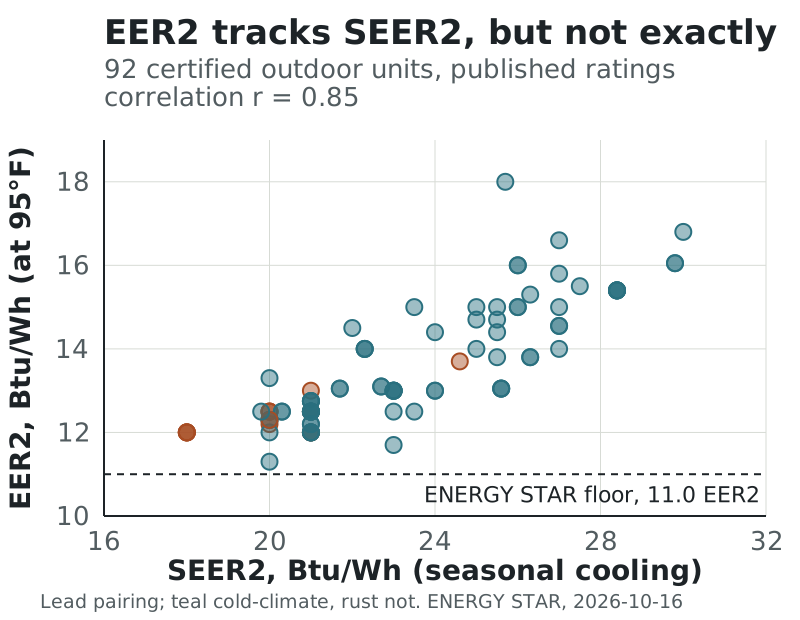
Closely, but not exactly. Across the 92 units, EER2 and SEER2 correlate at 0.85, much tighter than the 0.54 between SEER2 and HSPF2 that the SEER2 vs HSPF2 guide reports. A high-SEER2 unit is usually a high-EER2 unit.
The exceptions are where EER2 earns its place on the spec sheet:
- Six units publish SEER2 of exactly 27.0. Their EER2 runs from 14.0 (Carrier 38MPRBQ12AA3) to 16.6 (GREE GWH09ACD-D3DNA1A/O).
- The DELLA 048-C-TP-23K2V-23S-OUT sits 42nd of 92 on SEER2, at 23.0, and 91st on EER2, at 11.7. Part of that is size: it is a 24,000 BTU/h class unit.
- The Fujitsu AOU18RLXFWH goes the other way: 83rd on SEER2 at 20.0 and 38th on EER2 at 13.3.
- The Midea 37MAHAQ06AA3 is 23rd on SEER2 and first on EER2.
Two systems with the same SEER2 can therefore differ noticeably in what they draw on the hottest day.
Turning EER2 into watts
| Outdoor unit | Rated cooling, BTU/h | EER2 | Draw at 95°F |
|---|---|---|---|
| Midea 37MAHAQ06AA3 | 6,000 | 18.0 | about 333 W |
| Carrier 38MPRBQ12AA3 | 12,000 | 14.0 | about 857 W |
| 12,000 BTU/h class median | 12,000 | 13.05 | about 920 W |
| Daikin RXTH12AVJU* | 12,000 | 11.3 | about 1,062 W |
| DELLA 048-C-TP-23K2V-23S-OUT | 23,000 | 11.7 | about 1,966 W |
Between the best and worst 12,000 BTU/h unit in that table the difference is about 205 watts at the test point. At the U.S. Energy Information Administration's 2025 average residential price of 17.30 cents per kWh, that is about 3.5 cents per full-output hour. It adds up on a hot summer, and it matters more where peak-hour prices are higher, but it is a rating-condition figure, not a forecast. For seasonal cooling cost, use SEER2; the mini split electricity cost guide shows the method.
Why EER2 is always lower than SEER2
Every unit here publishes an EER2 well below its SEER2. Across the 92 lead pairings, EER2 runs between 0.51 and 0.70 of SEER2. The gap is not a quirk; it follows from what each rating averages.
SEER2 is built from a modelled season in which most cooling hours are moderate and the system runs at part load. A variable-speed mini split is at its most efficient there: the compressor slows, the coils are large relative to the heat being moved, and the temperature lift is small. EER2 is one full-load point at 95°F, where the lift is largest and the system is working hardest. A higher ratio means the system loses less efficiency between the average hour and the hard one; a lower ratio means its seasonal figure leans more on mild weather.
That ratio is not published anywhere and is not a rating in its own right. It is just arithmetic on the two published figures, and it is a quick way to see which systems are seasonal specialists and which hold up in the heat.
EER2, refrigerants and brands: correlations to read carefully
The dataset records each pairing's refrigerant: in this set, 50 outdoor units use R-410A, 32 use R-32 and 10 use R-454B. Their median EER2s differ, 13.75, 12.3 and 13.0 respectively, but the groups are also different brands and model families. The R-454B units here are all from two brands, and most of the R-32 units are from Daikin and LG. Any difference by refrigerant is tangled up with differences between manufacturers and product lines, and this sample cannot separate them.
The same caution applies to brand comparisons generally. This site's set is a deliberate sample of 92 outdoor units from a dataset of 17,874 mini or multi-split records, as the methodology page states. It is large enough to show how the ratings behave and too small to rank brands.
EER2 for a heat pump bought for heating
If the system's main job is winter heat, EER2 is a secondary figure. The cooling season in a heating-dominated climate is short, and the hottest afternoons are rare. The ratings that govern the bill there are HSPF2 for the season and the published capacity and COP at 5°F for the coldest hours. The heat pump COP guide covers the cold-weather counterpart of EER2.
EER2 still earns a glance in two cases. One is a house that is heated mainly by something else and is adding a heat pump for cooling and shoulder seasons, where summer may be the mode that matters. The other is a climate with real heat in summer and real cold in winter, where both single-point figures are worth reading.
Where EER2 sits in the rules
ENERGY STAR: at least 11.0 EER2 for split systems and 10.0 for single-package equipment. EER2 is not part of the cold-climate designation.
Federal minimums: 10 CFR 430.32(c)(5) sets 14.3 SEER2 and 7.5 HSPF2 for split-system heat pumps manufactured from 2023, with no EER2 figure. The regional requirements in 430.32(c)(6) add EER2 minimums in the Southwest — 11.7 or 9.8 depending on the certified SEER2, for units under 45,000 BTU/h — but they are written for split-system air conditioners.
Every unit here clears all of these: the lowest published EER2 is 11.3 and the lowest SEER2 is 18.0.
Reading EER2 on a listing
EER2 is the figure most often left off retail listings for mini-splits, which tend to lead with SEER2, HSPF2 and a nominal size. When it does appear, three checks keep it honest:
- Is it EER2 or EER? A figure from an older brochure or a pre-2023 listing is on the old test procedure and not comparable.
- Which pairing is it for? EER2 belongs to an indoor and outdoor combination. The Carrier 38MPRBQ09AA3 publishes EER2 of 16.0, 14.4 and 14.0 across its three certified indoor pairings, a spread of two full points on one outdoor unit.
- Which size class? Read it against the class table above rather than against the whole range.
The ENERGY STAR record for the exact pairing settles all three. Each model page on this site prints the record ID beside the figure, so the figure can be traced to its source row.
When EER2 is worth reading
- In a cooling-dominated climate. Where summer drives the bill, EER2 tells you about the hours that cost most.
- Where electricity is priced by time of day. The hottest afternoons often coincide with peak pricing.
- As a tie-breaker between similar SEER2 figures. Within a size class, a higher EER2 at the same SEER2 means less draw in the heat.
- Not as a heating guide. EER2 is a cooling rating. For heating, read HSPF2, then the capacity at 5°F and COP at 5°F.
Each model page in the certified systems register prints EER2 beside SEER2, HSPF2 and the 5°F figures, with the ENERGY STAR record ID it came from. What is EER2, in one line? The hot-afternoon cooling rating: heat removed per watt at 95°F, and the figure SEER2 averages away.
Sources
- ENERGY STAR Certified Heat Pumps, U.S. Environmental Protection Agency, Socrata dataset
83eb-xbyy. Retrieved 2026-10-16. Every EER2, SEER2 and capacity figure, and every count, median, rank and correlation, which are arithmetic on those published values. - ENERGY STAR, Heat Pump Equipment Key Product Criteria. Read 2026-10-17 for the EER2 definition and the 11.0 and 10.0 EER2 floors.
- Trane, glossary entry "What is EER?". Read 2026-10-17 for the EER2 test conditions.
- NYS Clean Heat, fact sheet on the DOE Appendix M1 test procedure. Read 2026-10-17 for the M1 changes, static pressure values and the statement that old and new ratings do not correlate.
- 10 CFR 430.32, Electronic Code of Federal Regulations. Read 2026-10-17 for the federal heat pump minimums and the Southwest EER2 requirements for split-system air conditioners.
- U.S. Energy Information Administration, Electricity explained: Factors affecting electricity prices. Read 2026-10-17 for the 2025 average residential price.
Frequently asked questions
What is a good EER2 rating?
ENERGY STAR requires at least 11.0 EER2 for a split-system heat pump, read from its key product criteria on 2026-10-17. Across the 92 certified ductless outdoor units on this site, published EER2 runs from 11.3 to 18.0 with a median of 13.0; 21 units publish 15.0 or more. Within a size class the spread is narrower: the 12,000 BTU/h class here runs from 11.3 to 14.4.
Is EER2 or SEER2 more important?
SEER2 describes the whole modelled cooling season, so it is the better guide to annual cooling energy. EER2 describes one hot operating point, so it is the better guide to the electrical draw on the hottest afternoons. In a hot climate, or where peak-hour electricity is expensive, EER2 deserves a look beside SEER2. For a heat pump bought mainly for heating, both matter less than HSPF2 and the capacity at 5°F.
How do I convert EER2 to watts?
Divide the cooling capacity in BTU per hour by EER2 to get watts at the rating point. A 12,000 BTU/h unit at the 12,000 BTU/h class median of 13.05 EER2 draws about 920 watts there; at 11.3 EER2, about 1,062 watts. That is the draw at the test condition with the unit delivering its rated output, not an average.
What is the difference between EER and EER2?
EER2 comes from the DOE Appendix M1 test procedure that took effect for equipment manufactured from January 1, 2023; EER came from the older procedure. A New York State fact sheet notes M1 raised the external static pressure used in testing to 0.5 inches of water column, from 0.1 to 0.2, and states that old and new ratings do not correlate. Compare EER2 only with EER2.
Does the federal minimum include EER2 for heat pumps?
Not in the general split-system heat pump standard. 10 CFR 430.32(c)(5) sets 14.3 SEER2 and 7.5 HSPF2 for split-system heat pumps manufactured from 2023. The regional EER2 requirements in 430.32(c)(6) for the Southwest apply to split-system air conditioners. ENERGY STAR adds its own 11.0 EER2 floor for certified split-system heat pumps.