Heat Pump Efficiency Chart: SEER2, EER2, HSPF2 and COP
Heat pump efficiency chart for 92 certified mini-splits: SEER2, EER2, HSPF2 and COP at 5°F by size, with the federal and ENERGY STAR floors beside them.
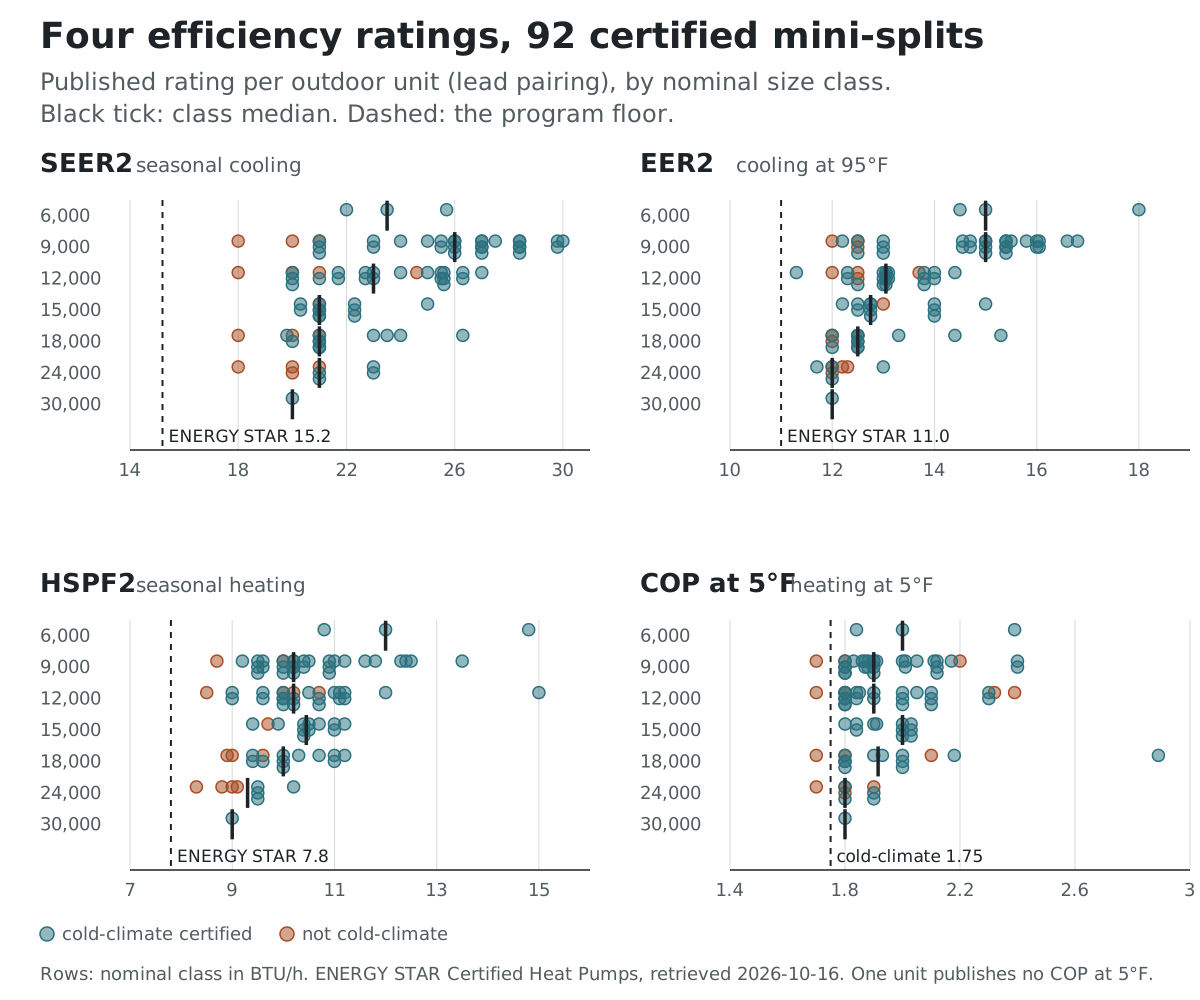
A heat pump efficiency chart puts the four ratings a mini-split publishes side by side: SEER2 for seasonal cooling, EER2 for cooling on a hot afternoon, HSPF2 for seasonal heating and COP at 5°F for heating in the cold. Across the 92 certified ductless outdoor units on this site, the medians are 22.85 SEER2, 13.0 EER2, 10.2 HSPF2 and 1.90 COP at 5°F, and every unit clears the ENERGY STAR floors of 15.2, 11.0 and 7.8 for the first three. The chart above plots every unit, one row per nominal size class.
This guide gives the chart as tables, by size class and by rating, explains what each rating measures, and shows three patterns the chart makes plain: smaller classes rate higher, cold-climate units rate higher on all four, and the four ratings do not rise and fall together.
The heat pump efficiency chart by size
Every figure below is the published rating of each outdoor unit's lead pairing in the ENERGY STAR Certified Heat Pumps dataset, retrieved 2026-10-16. Each cell gives the class median, with the lowest and highest published figures in brackets. The nominal class is ours, set from each unit's highest rated cooling capacity, as the methodology page records.
| Nominal class, BTU/h | Units | SEER2 | EER2 | HSPF2 | COP at 5°F |
|---|---|---|---|---|---|
| 6,000 | 3 | 23.5 (22.0 – 25.7) | 15.0 (14.5 – 18.0) | 12.0 (10.8 – 14.8) | 2.00 (1.84 – 2.39) |
| 9,000 | 30 | 26.0 (18.0 – 30.0) | 15.0 (12.0 – 16.8) | 10.2 (8.7 – 13.5) | 1.90 (1.70 – 2.40) |
| 12,000 | 24 | 23.0 (18.0 – 27.0) | 13.05 (11.3 – 14.4) | 10.2 (8.5 – 15.0) | 1.90 (1.70 – 2.39) |
| 15,000 | 12 | 21.0 (20.3 – 25.0) | 12.75 (12.2 – 15.0) | 10.45 (9.4 – 11.2) | 2.00 (1.80 – 2.03) |
| 18,000 | 14 | 21.0 (18.0 – 26.3) | 12.5 (12.0 – 15.3) | 10.0 (8.9 – 11.2) | 1.915 (1.70 – 2.89) |
| 24,000 | 8 | 21.0 (18.0 – 23.0) | 12.0 (11.7 – 13.0) | 9.3 (8.3 – 10.2) | 1.80 (1.70 – 1.90) |
| 30,000 | 1 | 20.0 | 12.0 | 9.0 | 1.80 |
| All units | 92 | 22.85 (18.0 – 30.0) | 13.0 (11.3 – 18.0) | 10.2 (8.3 – 15.0) | 1.90 (1.70 – 2.89) |
One 15,000 BTU/h unit publishes no COP at 5°F, so that column covers 11 units in its class and 91 overall. The 6,000 and 30,000 BTU/h rows hold three units and one unit, which is too few to call a typical figure; they are printed so the chart is complete, not as a guide to those sizes in general.
Read the table across a row to see what a typical unit of one size publishes, and down a column to see how one rating changes with size. Each of the 92 units has its own page in the certified systems register, where every pairing is listed separately with its ENERGY STAR record ID.
The heat pump efficiency chart by rating
The same data turned around: one row per rating, with the program floors beside the spread of published figures.
| Rating | What it rates | Federal minimum | ENERGY STAR floor | Cold-climate floor | Lowest here | Median | Top quarter from | Highest here |
|---|---|---|---|---|---|---|---|---|
| SEER2 | Seasonal cooling | 14.3 | 15.2 | 15.2 | 18.0 | 22.85 | 25.7 | 30.0 |
| EER2 | Cooling at 95°F | none in (c)(5) | 11.0 | none | 11.3 | 13.0 | 14.7 | 18.0 |
| HSPF2 | Seasonal heating | 7.5 | 7.8 | 8.5 | 8.3 | 10.2 | 11.0 | 15.0 |
| COP at 5°F | Heating at 5°F | none | none | 1.75 | 1.70 | 1.90 | 2.03 | 2.89 |
The federal minimums are from 10 CFR 430.32(c)(5), the row for split-system heat pumps manufactured on or after January 1, 2023. The ENERGY STAR and cold-climate floors are from the program's key product criteria; the cold-climate HSPF2 floor shown is the one for non-ducted split systems, which is what every unit on this site is. "Top quarter from" is the lowest of the 23 highest published figures, a quarter of the 92 units: 23 units sit at or above it for SEER2, EER2 and HSPF2, and 24 of the 91 that publish one for COP at 5°F, because three units publish 2.03 and the cut falls between them.
Two rows stand out. SEER2 is the rating with the most headroom: the lowest unit here publishes 18.0 against a 15.2 floor, so the floor decides nothing in this set. COP at 5°F is the tightest: the median is only 0.15 above the cold-climate floor, and the lowest units publish 1.70, which is below it. Those units are certified ENERGY STAR without the cold-climate designation, which is allowed; the cold-climate criteria guide shows which test each of them misses.
What each rating on the chart measures
All four are ratios of heat moved to electricity used, measured under the Department of Energy's Appendix M1 test procedure. ENERGY STAR's key product criteria, read on 2026-10-26, define them this way:
- SEER2 is seasonal cooling efficiency: the total heat removed from the conditioned space over the annual cooling season, divided by the electrical energy used in that period, in BTU per watt-hour.
- EER2 is the average rate of space cooling delivered divided by the average rate of electrical energy consumed, in BTU per watt-hour, at one operating point. The EER2 guide covers its 95°F test condition.
- HSPF2 is seasonal heating efficiency: the total space heating output over the heating season in BTU, divided by the electrical energy used in watt-hours, for a standard climate region.
- COP is a dimensionless ratio of the average rate of space heating delivered to the average rate of electrical energy consumed, determined from a single test or a single set of operating conditions. The cold-climate criteria measure it at 5°F.
The pattern is a two-by-two. SEER2 and HSPF2 are seasonal averages, one per mode. EER2 and COP at 5°F are single points at the hard end of each mode: the hot afternoon and the cold night. The SEER2 vs HSPF2 guide walks through why the seasonal pair answers a different question from the single-point pair.
Turning the ratings into watts
Because the units are BTU per watt-hour, two of the ratings convert into plain electrical terms with arithmetic and nothing else.
EER2 converts into watts at its test point: cooling capacity in BTU/h divided by EER2. Per 12,000 BTU/h of cooling, the median EER2 of 13.0 means about 923 watts; the lowest here, 11.3, means about 1,062 watts; the highest, 18.0, about 667 watts.
HSPF2 converts into a seasonal COP by dividing by 3.412, the number of BTU in a watt-hour. The median HSPF2 of 10.2 corresponds to a seasonal COP of about 2.99; the lowest here, 8.3, to about 2.43; the highest, 15.0, to about 4.40. That is a ratio over the standard test season, not a forecast for any house. The COP guide explains why a seasonal COP and a COP at 5°F are different numbers for the same unit.
Pattern one: smaller classes rate higher
The chart's rows slope. Take the two classes with the most units, 9,000 and 12,000 BTU/h, and the two largest common classes, 18,000 and 24,000 BTU/h:
| Rating | 9,000 median | 12,000 median | 18,000 median | 24,000 median |
|---|---|---|---|---|
| SEER2 | 26.0 | 23.0 | 21.0 | 21.0 |
| EER2 | 15.0 | 13.05 | 12.5 | 12.0 |
| HSPF2 | 10.2 | 10.2 | 10.0 | 9.3 |
| COP at 5°F | 1.90 | 1.90 | 1.915 | 1.80 |
The cooling ratings fall most clearly with size. EER2's median drops by three points from the 9,000 to the 24,000 BTU/h class, and no 24,000 BTU/h unit here publishes more than 13.0, against a 9,000 BTU/h median of 15.0. HSPF2 holds level through 12,000 BTU/h and then falls. COP at 5°F barely moves.
The practical reading is that a rating should be judged against units of the same size. A 24,000 BTU/h system at 10.2 HSPF2 is at the top of its class here; a 9,000 BTU/h system at 10.2 is at the median of its class. The same number means something different in each row, which is why each model page on this site lists comparable systems by class rather than across the whole register.
Pattern two: cold-climate units rate higher on all four
ENERGY STAR's cold-climate designation is mostly a low-temperature test, but the units that carry it also publish higher figures on the ratings the designation does not test.
| Rating | Cold-climate certified, median | Not cold-climate, median | Not cold-climate, range |
|---|---|---|---|
| SEER2 | 23.0 (77 units) | 20.0 (15 units) | 18.0 – 24.6 |
| EER2 | 13.1 | 12.3 | 12.0 – 13.7 |
| HSPF2 | 10.4 | 9.1 | 8.3 – 10.7 |
| COP at 5°F | 1.90 | 1.80 (14 units) | 1.70 – 2.39 |
The gap is clearest on HSPF2: the cold-climate units' median is 1.3 points higher. But the ranges overlap, and the not-certified group includes units with strong ratings. The CanAir C25SCH12H21 publishes 24.6 SEER2, 10.7 HSPF2 and a COP at 5°F of 2.39, all above this set's medians, and is still not cold-climate certified. Its published heating capacity falls from 12,000 BTU/h at 47°F to 8,000 BTU/h at 5°F, which is 67%, below the 70% the designation requires.
That example is the limit of any efficiency chart. Efficiency is how much heat a unit makes per unit of electricity; capacity is how much heat it makes at all. A chart of ratings shows the first and says nothing about the second.
Pattern three: the four ratings do not move together
A unit that leads on one rating often sits in the middle on another. Of the 23 units in the top quarter for HSPF2 (11.0 or higher), only 10 are also in the top quarter for COP at 5°F (2.03 or higher). The two cooling ratings track each other closely, as the EER2 guide plots; the two heating ratings track each other much more loosely.
Only four of the 92 units reach the top quarter on all four ratings:
| Outdoor unit | Class, BTU/h | SEER2 | EER2 | HSPF2 | COP at 5°F | 5°F capacity, BTU/h |
|---|---|---|---|---|---|---|
| Midea 37MAHAQ06AA3 | 6,000 | 25.7 | 18.0 | 14.8 | 2.39 | 7,700 |
| TOSOT TW09HAY32A1DO | 9,000 | 30.0 | 16.8 | 11.2 | 2.11 | 11,500 |
| LG KUSAL091A | 9,000 | 27.0 | 15.8 | 13.5 | 2.05 | 12,000 |
| Carrier 38MPRBQ18AA3 | 18,000 | 26.3 | 15.3 | 11.0 | 2.89 | 24,000 |
All four are cold-climate certified. Three are small units, which fits pattern one. The Carrier 38MPRBQ18AA3 is the exception: an 18,000 BTU/h class unit with the highest COP at 5°F in the set and a published capacity at 5°F above its 47°F figure.
The single highest figure on each rating belongs to a different unit. The TOSOT TW09HAY32A1DO leads on SEER2 at 30.0, the Midea 37MAHAQ06AA3 on EER2 at 18.0, the Carrier 38MPRBQ09AA3 on HSPF2 at 15.0, and the Carrier 38MPRBQ18AA3 on COP at 5°F at 2.89. A chart sorted by one rating will rank the set differently from a chart sorted by another.
The lowest figures on the chart
The bottom of the chart is dominated by one product line. The four LG KUSAE units each publish 18.0 SEER2 and 1.70 COP at 5°F, and three of them hold the lowest HSPF2 figures here: 8.3 for the KUSAE241A, 8.5 for the KUSAE121A and 8.7 for the KUSAE091A. All clear the ENERGY STAR floors and none carries the cold-climate designation. The lowest EER2 belongs to a cold-climate unit, the Daikin RXTH12AVJU* at 11.3, which also publishes as much heating capacity at 5°F as at 47°F, 13,500 BTU/h at both: low on a cooling rating, strong on cold-weather output.
Being at the bottom of this chart is still being certified. Every unit here is ENERGY STAR certified, and every unit clears the federal minimums by a wide margin on SEER2 and by at least 0.8 on HSPF2.
How to use a heat pump efficiency chart
The ratings are rating-condition metrics. They describe the equipment under a fixed laboratory procedure, not what it will do in a particular climate or house, and two systems with the same rating can use different amounts of electricity in the same home. Used as comparisons, they are useful in a fixed order.
- Start from size. Pick the nominal class from a load calculation, not from the efficiency chart. The sizing guide covers why heating size needs the 5°F capacity, not the label.
- Read the rating that matches the job. Where heating governs the year, HSPF2 first; where cooling does, SEER2. In a cold climate, read COP at 5°F as well.
- Compare within the class row. Use the by-size table above, or filter the register by class, rather than the overall median.
- Then check capacity. Efficiency does not say whether a unit keeps up on a cold night. The published capacity at 5°F does, and the capacity at 5°F guide explains how to read it.
- Turn ratings into money only with your own prices. The running-cost calculator takes an HSPF2 and your electricity and gas prices and works through a heating scenario, with its assumptions on the page.
A heat pump efficiency chart is the quickest way to see where a unit sits among its peers, as long as it is read by size and paired with the capacity figures it leaves out.
Sources
- ENERGY STAR Certified Heat Pumps, U.S. Environmental Protection Agency, Socrata dataset
83eb-xbyy. Retrieved 2026-10-16. Every SEER2, EER2, HSPF2, COP at 5°F and capacity figure, and every count, median, percentile position and range, which are arithmetic on the lead pairing's published values for the 92 outdoor units on this site. - ENERGY STAR, Heat Pump Equipment Key Product Criteria. Read 2026-10-26 for the definitions of SEER2, EER2, HSPF2 and COP, the split-system floors (15.2 SEER2, 11.0 EER2, 7.8 HSPF2) and the cold-climate requirements for non-ducted split systems (8.5 HSPF2, 15.2 SEER2, COP at 5°F of 1.75, 70% of 47°F capacity at 5°F).
- 10 CFR 430.32(c)(5), Electronic Code of Federal Regulations. Read 2026-10-26 for the 14.3 SEER2 and 7.5 HSPF2 minimums for split-system heat pumps manufactured on or after January 1, 2023.
Frequently asked questions
What is a good efficiency rating for a mini split heat pump?
Against the floors, every certified system already clears ENERGY STAR's 15.2 SEER2, 11.0 EER2 and 7.8 HSPF2. Against the 92 certified ductless outdoor units on this site, the medians are 22.85 SEER2, 13.0 EER2, 10.2 HSPF2 and 1.90 COP at 5°F, and the top quarter starts at 25.7 SEER2, 14.7 EER2, 11.0 HSPF2 and 2.03 COP at 5°F. Compare within the size class you need, because smaller classes post higher medians on most of these ratings.
Which efficiency rating matters most for heating?
HSPF2 is the seasonal heating rating and is the one the federal and ENERGY STAR floors use for heating. COP at 5°F is a single cold-weather test point, and ENERGY STAR's cold-climate criteria set a floor of 1.75 for it. Neither says how much heat a unit still makes when it is cold outside; that is the published heating capacity at 5°F, which a chart of efficiency ratings does not show.
Are bigger heat pumps more efficient?
Not in this set. The median EER2 falls from 15.0 in the 9,000 BTU/h class to 12.0 in the 24,000 BTU/h class, and the median HSPF2 from 10.2 to 9.3. SEER2 shows the same direction, from a 26.0 median at 9,000 BTU/h to 21.0 at 24,000 BTU/h. A larger system is not a more efficient one, so compare ratings inside the size you need.
What are the minimum SEER2 and HSPF2 ratings for a heat pump?
For split-system heat pumps manufactured from January 1, 2023, 10 CFR 430.32(c)(5) sets 14.3 SEER2 and 7.5 HSPF2. ENERGY STAR certification for split systems asks for at least 15.2 SEER2, 11.0 EER2 and 7.8 HSPF2. Its cold-climate designation for non-ducted split systems raises HSPF2 to 8.5 and adds a COP of at least 1.75 at 5°F and at least 70% of the 47°F heating capacity at 5°F.
Does a higher efficiency rating mean a lower bill in my house?
Not directly. SEER2, EER2, HSPF2 and COP at 5°F are measured under fixed laboratory conditions in the DOE Appendix M1 procedure, not in any particular climate or house. Two systems with the same rating can use different amounts of electricity in the same house, and the same system uses different amounts in different climates. The ratings are for comparing equipment, not for predicting a bill.