How Many Watts Does a Heat Pump Use? Rated Watts by Size
How many watts does a heat pump use? At the rating points, 333 to 2,750 W cooling and 653 to 5,861 W heating at 5°F, across 92 certified mini-splits.
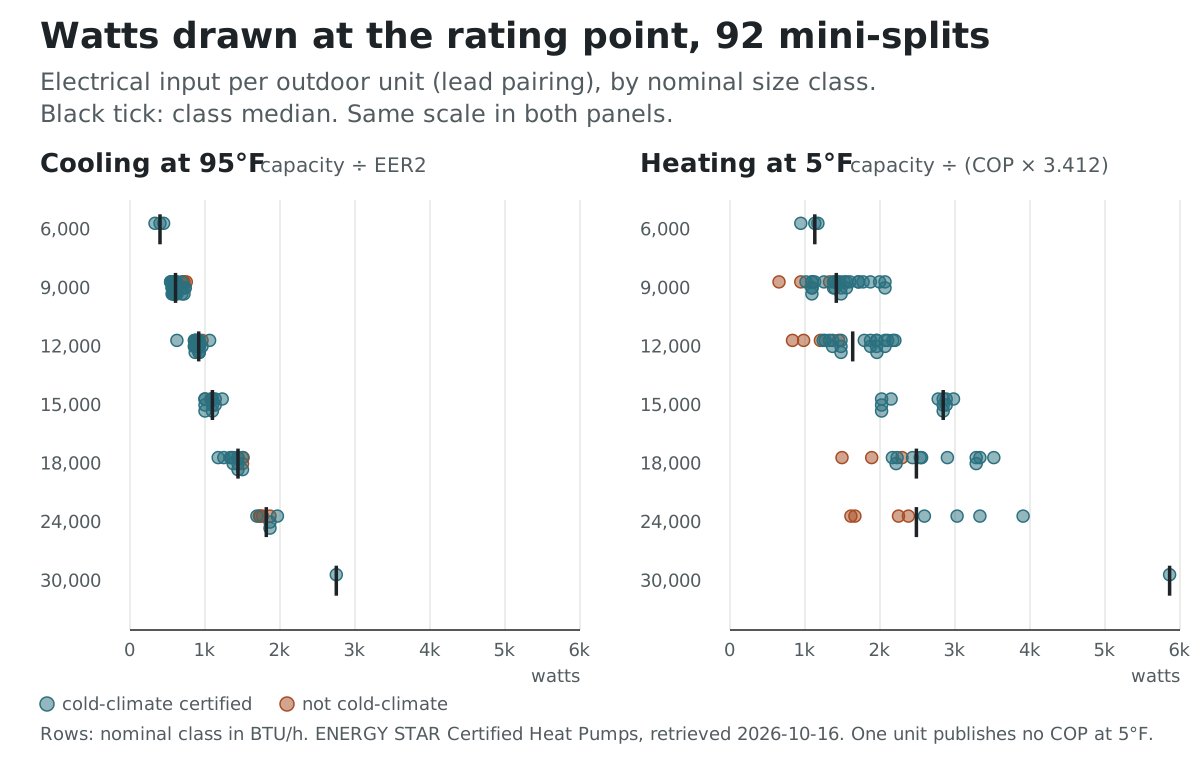
How many watts does a heat pump use? The published ratings answer it at two test points. Across the 92 certified ductless outdoor units on this site, cooling at 95°F draws between 333 and 2,750 watts, with a median of 918, and heating at 5°F draws between 653 and 5,861 watts, with a median of 1,872. Each figure is two numbers from the unit's ENERGY STAR record divided into each other, and the chart above plots every unit by size.
This guide shows the arithmetic, gives the figures by size class, explains why heating in the cold draws about twice as much as cooling on a hot afternoon, and sets out what a watt figure cannot tell you: how much electricity a heat pump uses over a day or a season, which depends on the house and the weather.
The two formulas
ENERGY STAR publishes, for each certified outdoor and indoor pairing, a rated cooling capacity and EER2, and a rated heating capacity at 5°F and the COP at 5°F. Both pairs convert into electrical input with nothing but division.
Cooling, from EER2. EER2 is cooling output in BTU per hour divided by electrical input in watts at one test point. ENERGY STAR's key product criteria define it as the average rate of space cooling delivered divided by the average rate of electrical energy consumed, in BTU per watt-hour. Turned around:
watts = cooling capacity in BTU/h ÷ EER2
The EER2 guide covers its test condition: 95°F outdoors, the hot-afternoon end of the cooling season.
Heating at 5°F, from COP. COP is heat delivered divided by electricity consumed, in the same units. Heat output is published in BTU per hour, and one watt is 3.41214 BTU per hour, so:
watts = heating capacity at 5°F in BTU/h ÷ (COP at 5°F × 3.41214)
The COP guide explains why COP falls as the outdoor temperature falls, and why a COP at 5°F is a different number from the seasonal efficiency HSPF2 describes.
Both results are the electrical input at the published rating point, for the published capacity. Nothing is estimated: if a record lacks one of the two figures, no watt figure is given for it. One 15,000 BTU/h unit, the Mitsubishi Electric MUZ-GL15NAH***, publishes no 5°F capacity or COP, so the heating column covers 91 units, not 92.
A worked example
The Mitsubishi Electric MUZ-FS12NA***, with its lead indoor pairing, publishes:
- cooling capacity 12,000 BTU/h at EER2 13.8, so 12,000 ÷ 13.8 = about 870 watts cooling at 95°F;
- heating capacity at 5°F of 14,700 BTU/h at a COP of 2.3, so 14,700 ÷ (2.3 × 3.41214) = about 1,873 watts heating at 5°F.
Its own model page lists every pairing separately; a different indoor head changes the published figures, and so the watts.
How many watts by size
Every figure below is worked out from the lead pairing of each outdoor unit in the ENERGY STAR Certified Heat Pumps dataset, retrieved 2026-10-16. Each cell gives the class median, with the lowest and highest unit in brackets. The nominal class is ours, set from each unit's highest rated cooling capacity, as the methodology page records.
| Nominal class, BTU/h | Units | Cooling at 95°F, watts | Heating at 5°F, watts |
|---|---|---|---|
| 6,000 | 3 | 400 (333 – 448) | 1,131 (944 – 1,172) |
| 9,000 | 30 | 607 (542 – 750) | 1,417 (653 – 2,067) |
| 12,000 | 24 | 916 (625 – 1,062) | 1,636 (834 – 2,198) |
| 15,000 | 12 | 1,098 (1,000 – 1,230) | 2,843 (2,021 – 2,980), 11 units |
| 18,000 | 14 | 1,440 (1,176 – 1,508) | 2,485 (1,493 – 3,517) |
| 24,000 | 8 | 1,817 (1,692 – 1,966) | 2,485 (1,612 – 3,908) |
| 30,000 | 1 | 2,750 | 5,861 |
| All units | 92 | 918 (333 – 2,750) | 1,872 (653 – 5,861), 91 units |
The 6,000 and 30,000 BTU/h rows hold three units and one unit. They are printed so the table is complete, not as a typical figure for those sizes.
Three things about the table matter more than any single cell.
The cooling column rises steadily with size. Cooling capacity is close to the class label for most units, and EER2 varies less than capacity does, so the median cooling draw roughly tracks the class: about 600 watts at 9,000 BTU/h, about 900 at 12,000, about 1,400 at 18,000, about 1,800 at 24,000. Larger classes also publish lower EER2 medians on this site, which is why the step from 9,000 to 24,000 BTU/h triples the draw rather than merely scaling with capacity.
The heating column does not. The 15,000 BTU/h class has a higher median heating draw at 5°F than the 18,000 and 24,000 BTU/h classes. Seven of its eleven units with a 5°F rating publish more than 15,000 BTU/h of heat at 5°F, from Mitsubishi Electric (one of them its Trane co-branded listing), Fujitsu, Daikin and LG: the MUZ-FS15NA*** lists 19,400 BTU/h at 5°F against 14,000 BTU/h of rated cooling. More heat out at a similar COP means more watts in. A heating watt figure reflects how much the unit is rated to deliver in the cold, not only its label.
The spread inside a class is wide. In the 9,000 BTU/h class, heating at 5°F runs from 653 to 2,067 watts, a factor of three, because 5°F capacities in that class run from 4,900 to 13,400 BTU/h. Two units with the same label can draw very different amounts in the cold, and the reason is usually output, not efficiency.
Watts per ton of cooling
A ton of cooling is 12,000 BTU/h, so the watts per ton at the EER2 test point are 12,000 ÷ EER2. Across the 92 units on this site:
| EER2 | Watts per 12,000 BTU/h of cooling | |
|---|---|---|
| Highest EER2 here | 18.0 | about 667 |
| Median | 13.0 | about 923 |
| Lowest EER2 here | 11.3 | about 1,062 |
Per ton is the fairest way to compare cooling draw across sizes, because it removes capacity from the comparison and leaves only the rating. It is also how to answer a question about a size this site does not hold, such as a 5-ton system.
What about a 5-ton heat pump?
A nominal 5-ton system is 60,000 BTU/h of cooling. Its draw at the rating point is 60,000 ÷ its own EER2, and its heating draw at a given temperature is its rated heating capacity at that temperature ÷ (its COP there × 3.41214). Both figures are on its spec sheet and, for certified equipment, in the same ENERGY STAR dataset.
This site does not give a figure for one, for two reasons. No 5-ton system is in the set: the largest unit here, the Lennox 3WPD036S6S-1P*, rates 33,000 BTU/h of cooling, at EER2 12.0, about 2,750 watts, and 36,000 BTU/h of heat at 5°F at a COP of 1.8, about 5,861 watts. And every unit here is a ductless outdoor unit; this site holds no ducted central system records, so these ratings are not a stand-in for one. Multiplying a ductless per-ton figure by five would produce a figure that is not any 5-ton unit's rating.
Why heating at 5°F draws about twice as much
Of the 91 units that publish a COP at 5°F, 86 draw more watts heating at 5°F than cooling at 95°F, and the median unit draws about 2.07 times as much. Two published facts explain it.
The heat output asked for is larger. At 5°F the house is losing heat fast, and the rating records the unit's heat output at that temperature. For cold-climate units on this site, that output is often near or above the rated cooling capacity: the MUZ-FS12NA*** delivers 14,700 BTU/h at 5°F against 12,000 BTU/h of rated cooling.
The efficiency at that point is lower. A COP of 1.90, the median here, means 1.90 units of heat per unit of electricity. Cooling at the EER2 point is more efficient per watt: the median EER2 of 13.0 is the same as a COP of about 3.8 (13.0 ÷ 3.412). More heat out at half the efficiency means about twice the electricity in.
The five exceptions are all Daikin units whose published 5°F capacity is far below their 47°F capacity. The RXF09AXVJU publishes 10,000 BTU/h at 47°F but 4,900 BTU/h at 5°F, at a COP of 2.2: about 653 watts at 5°F against about 720 cooling. It draws less in the cold because it makes less heat in the cold, not because it is more efficient there.
The same pattern shows up in the cold-climate designation. The 77 cold-climate certified units with a 5°F rating publish a median 5°F capacity of 12,300 BTU/h and a median heating draw of about 1,954 watts. The 14 without the designation publish a median 5°F capacity of 9,150 BTU/h and draw about 1,471 watts. The cold-climate criteria guide shows which tests each of those units misses.
Lower watts is not the same as more efficient
The heating column invites the wrong reading: that the unit drawing the fewest watts is the best one. Compare two 9,000 BTU/h class units at 5°F:
| Outdoor unit | Heat delivered at 5°F | COP at 5°F | Watts at 5°F |
|---|---|---|---|
| Daikin RXF09AXVJU | 4,900 BTU/h | 2.2 | about 653 |
| Mitsubishi Electric MUZ-FS09NAH*** | 11,300 BTU/h | 2.4 | about 1,380 |
The Mitsubishi unit draws about twice the watts, delivers 2.3 times the heat, and does it at a higher COP. Per unit of heat, it uses less electricity. On a cold night, the Daikin unit's shortfall has to come from somewhere, usually backup resistance heat at a COP of 1, which takes 293 watts for every 1,000 BTU/h.
So read watts as what they are, a rate of electricity use at a given output, and read efficiency and capacity separately:
- COP or HSPF2 for how much electricity each unit of heat costs. The efficiency chart sets them out by size.
- Capacity at 5°F for whether the unit keeps up when it is cold. The capacity at 5°F guide explains how to read it.
- Watts for questions about the electrical supply and the instantaneous rate, at the conditions the rating describes.
What a rated watt figure does not tell you
The figures above are rating-condition metrics. They are worth knowing, and they are easy to misuse.
They are not the maximum draw. The rating records one operating point. A variable-speed compressor can run faster or slower than that point, and the electrical figures that size a circuit, such as minimum circuit ampacity and maximum overcurrent protection, are on the unit's nameplate and installation manual, not in the ENERGY STAR record. This site does not hold them, and a rated watt figure is not a substitute for them.
They are not the typical draw either. Most hours of a heating or cooling season are milder than 95°F or 5°F. All 92 outdoor units on this site publish a continuously variable compressor, and at part load such a unit slows down and draws less than its rated figure. That is the reason the seasonal ratings, SEER2 and HSPF2, exist: they average performance over a standard season instead of one hard point.
They are not energy use. Watts are a rate. Energy is watts multiplied by hours, and how many hours a heat pump runs, at what speed, depends on the house's heat loss or gain and the weather. Running for one hour at exactly the rated cooling point, the MUZ-FS12NA*** would use about 0.87 kWh; nothing in the rating says how many such hours a season holds.
They are for one pairing. Ratings are published per outdoor and indoor pairing, and the indoor head changes them. Every figure on this page uses the lead pairing that each model page shows first; the model page lists the others.
From watts to a monthly or yearly figure
To turn electrical input into a bill, the question changes from "how many watts?" to "how many kWh over the season?", and that needs the heat the house needs, not the heat pump's draw. The method, set out with real ratings in the mini split electricity cost guide, is:
- Find the house's seasonal heating or cooling load in BTU, from a load calculation or from past fuel use.
- Divide by HSPF2 for heating, or SEER2 for cooling, and then by 1,000, to get kWh.
- Multiply by your own marginal price per kWh from your bill.
The running-cost calculator does that arithmetic for heating with your own prices and compares it with a gas furnace, showing every step. Multiplying a rated watt figure by a guessed number of hours skips the load and tends to mislead, because the hours a unit spends at its rated point are a small share of the season.
If you need a figure for a specific unit, open its page in the certified systems register: every pairing is listed with its cooling capacity, EER2, 5°F capacity and COP at 5°F, the four numbers the two formulas need. With them, how many watts does a heat pump use is a question each spec sheet answers at its own rating points.
Sources
- ENERGY STAR Certified Heat Pumps, U.S. Environmental Protection Agency, Socrata dataset
83eb-xbyy. Retrieved 2026-10-16. Every cooling capacity, EER2, heating capacity at 47°F and 5°F and COP at 5°F figure, and every watt figure, count, median and range on this page, which are arithmetic on the lead pairing's published values for the 92 outdoor units on this site.node scripts/make-watts-chart.mjsreprints the class table. - ENERGY STAR, Heat Pump Equipment Key Product Criteria. Read 2026-10-26 for the definitions of EER2 and COP used in the two formulas.
- The conversion of 3.41214 BTU per hour per watt is the standard definition of the British thermal unit (International Table) in watts, used throughout this site.
Frequently asked questions
How many watts does a heat pump use?
At its published rating points, a certified ductless heat pump on this site draws between 333 and 2,750 watts when cooling at 95°F, with a median of 918 watts, and between 653 and 5,861 watts when heating at 5°F, with a median of 1,872 watts. Those are rated cooling capacity divided by EER2 and rated 5°F heating capacity divided by COP times 3.412, for the 92 outdoor units in the ENERGY STAR data on this site. Between those test points a variable-speed unit runs slower and draws less.
How many watts does a 12,000 BTU mini split use?
In the 12,000 BTU/h class on this site, cooling at the EER2 test point draws a median of 916 watts, from 625 to 1,062 watts across 24 units. Heating at 5°F draws a median of 1,636 watts, from 834 to 2,198. The Mitsubishi Electric MUZ-FS12NA*** publishes 12,000 BTU/h at EER2 13.8, about 870 watts, and 14,700 BTU/h at 5°F at a COP of 2.3, about 1,873 watts.
How many watts does a 5 ton heat pump use?
Divide its rated cooling capacity, 60,000 BTU/h for a nominal 5-ton system, by the EER2 on its own spec sheet or ENERGY STAR record; for heating, divide the rated heating capacity at the temperature you care about by the COP at that temperature times 3.412. No 5-ton system is among the 92 ductless units on this site, whose largest rates 33,000 BTU/h of cooling, so no figure for one is given here. Across this set, each 12,000 BTU/h of cooling draws between 667 and 1,062 watts at the rating point.
Does a heat pump use more watts heating or cooling?
At the published test points, heating at 5°F draws more for 86 of the 91 units that publish a COP at 5°F, and the median unit draws about twice as many watts heating at 5°F as cooling at 95°F. The reason is that the 5°F test asks for full heat output in the cold, where the COP is lower. The five exceptions are Daikin units whose published 5°F capacity is far below their 47°F capacity, so they draw less because they deliver less heat.
Is a lower wattage heat pump more efficient?
Not by itself. Watts are a rate of electricity use; efficiency is heat moved per unit of electricity. The lowest heating draw at 5°F on this site, 653 watts, belongs to a Daikin RXF09AXVJU that delivers 4,900 BTU/h at that point, while the Mitsubishi Electric MUZ-FS09NAH*** draws about 1,380 watts and delivers 11,300 BTU/h. Compare the COP or HSPF2 for efficiency, and the capacity for whether the unit keeps up.